campus news
AI Summit helps shape higher education’s role in AI for the public good

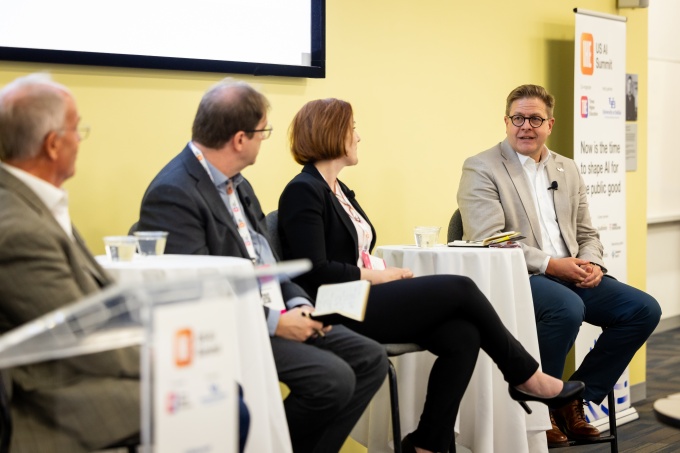
Nearly 200 leaders from universities, government and industry attended the IHE US AI Summit 2026, where Dean Jeff Grabill helped lead the conversation on how higher education can help shape the future of AI for the public good.
By JACKIE HAUSLER and VICKY SANTOS
Published June 22, 2026
The US AI Summit hosted by UB, in partnership with Times Higher Education and Inside Higher Ed, brought together nearly 200 participants from universities, government and industry organizations from across the nation and internationally for a two-day symposium to discuss and collaborate on the future of AI for the public good.
The summit discussed higher education’s roles and responsibilities in shaping what purposes AI serves in and out of the classroom. Attendees discussed its academic, environmental, social, human-centered and economic impacts. “Unlike most conferences, this meeting will produce a statement – a manifesto of sorts – and the work we’ve been doing together for the past two days has been focused on creating that statement,” says Jeff Grabill, dean of the College of Arts and Sciences.
Grabill moderated a panel on day two of the summit titled, “The 2030 roadmap: What are the biggest priorities?” that in-part highlighted Empire AI at UB. The panel discussed the future of AI, how we can future-proof institutions to be resilient to the rapid growth of technology and the role of higher education beyond the classroom. Grabill asked panelists thought-provoking questions about what the future of AI will look like over the next five years; How can we future-proof institutions to be resilient to the rapid growth of technology? And, what will be the role of higher education beyond the classroom?
“These are urgent, existential issues and we must figure out what our role should be as researchers and educators working at institutions of higher learning,” says David Castillo, professor of Spanish in the Department of Romance Languages and Literatures and co-director of the Center for Information Integrity. “This summit was an opportunity to get a sense of how conversations on and around AI and society are being framed and what colleagues view as the most pressing challenges and potential opportunities,” he adds.
Sarah Muldoon, associate professor in the Department of AI and Society, was also in attendance. “It’s an exciting and fast-moving time for our department right now as we hire faculty and develop degrees,” says Muldoon. “We want to make sure we are prepared to keep up with the pace of AI development and train students who are prepared to exist in an AI-integrated world.”
Throughout the course of the conference, Miro, an AI visual collaboration tool, was used to document thoughts, conversations and feedback from participants.
“The reason that we facilitated the meeting as we have - and used Miro - is so that we could write together.” Grabill says attendees will receive a draft of the document as a follow-up from the work, conversations and progress made at the conference and to give them a post-summit opportunity to engage, reflect and give feedback.
“The intention is to share this with the world and try to facilitate a conversation that extends beyond this room in beautiful Buffalo, New York, and see if we can make a difference,” he adds.