Campus news
UB faculty artist reimagines Sabres “Goathead” logo for Black History Month

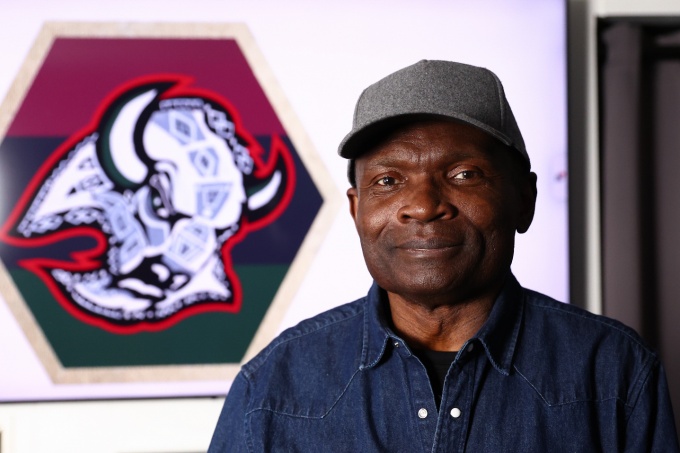
George Afedzi Hughes, head of painting in the Department of Art, stands in front of his redesigned Buffalo Sabres “goathead” logo featuring Pan-African colors and African symbols for Black History Month. Photo credit: Buffalo Sabres
By VICKY SANTOS
George Afedzi Hughes, head of painting in the Department of Art and a native of Ghana, created a new Buffalo Sabres logo to commemorate Black History Month as part of the team’s Community Artist Series. Hughes is the third artist to participate in the series, and the first to work from the Sabres’ throwback “goathead” logo rather than the team’s primary crest.
Hughes said he was invited to take part in the series after being contacted by Aaron Ott, public art curator at the Buffalo AKG Art Museum, who helped connect Hughes with the Sabres’ ongoing partnership celebrating local artists.
“We started off with the original ‘goathead’ logo because the Sabres’ staff wanted the fans to recognize the final result of the project,” Hughes said.
In keeping with the recognizable form, Hughes began to build in African symbols into the existing logo. One of the reoccurring symbols in the new logo is the shape of diamonds.
“The diamond overlap symbolizes law and justice, and the diamond in itself represents beauty and strength. The diamond within a diamond represents strategic work,” Hughes said in an interview on the Sabres website. “The fractured arrow on the forehead of the bull, even though the grey arrow is fractured, the peaks of the diamonds point to one each other and showing they're demonstrate continuation through blood and lineage, through heritage,” Hughes explained.
To reinforce the symbol of strength and unity, Hughes incorporated a hexagon boundary around the goat head. “The hexagon was introduced into the design as a reference to the efficient structure of the shape, which represents interconnectedness, balance, and harmony. The surface of the logo was inscribed with Adinkra proverbial symbols, which are often used as designs on fabric by the Akan ethnic group in Ghana, each carrying layered meanings,” Hughes said.
The Pan-African flag is used in the background and Hughes says the flag was created in 1920 to represent people of the African Diaspora and to symbolize black liberation in the United States.
The final logo incorporates the red, black, and green of the Pan-African flag – colors symbolizing blood, people of African descent, and Africa’s rich natural resources.
“I think the logo shows that African Americans contribute to so many sectors of society. And being a black person, I’m happy to contribute to make the Sabres team a successful team using my art.”
“The Africanized Sabres logo is chic, I just love it,” Hughes says.
Hughes hopes the design encourages conversations that extend beyond sports. “Conversations about art, fashion, heritage, sports—and also the expansion of the fan base, since it celebrates Black History Month,” he said.
The design was printed on a set of Sabres practice jerseys, which were displayed in the KeyBank Center concourse during the team’s Black History Celebration game against the Los Angeles Kings on Jan. 29. The jerseys were auctioned off to benefit the Buffalo Center for Arts and Technology (BCAT), which offers free adult workforce training and youth afterschool programs throughout the Buffalo area. The auction raised $7,000 in proceeds, which will be donated to BCAT on top of the initial $100,000 grant from the Sabres Foundation.
“I am happy that proceeds from the project will go to support the Buffalo Center for Arts and Technology,” Hughes said.
As both a practicing artist and an educator, Hughes sees projects like this as an extension of his teaching philosophy. In the classroom, he encourages students to embrace uncertainty and creative risk. “I am always encouraging students to be prolific beyond expectation,” he said. “This puts the student in an advantageous position to meet unforeseen demands for their work—exhibitions, collaborations, sales, and exposure.”
He believes students benefit from learning alongside faculty who are actively engaged in the field. “Students gain real-life experiences and references to a lived process,” Hughes said. “I am able to demystify the myths about the difficulties of being an artist and also project a positive attitude and professionalism.”
Ultimately, Hughes hopes viewers walk away from his work with a sense of altered perception. “I hope people who engage with my work would have an aesthetic experience different from how they know the physical world,” he said.
Looking ahead, Hughes says he will continue building on his current practice. “I plan on finishing in-progress projects and collaborating with artists with similar artistic goals,” he said.