Award news
Vanouse awarded prestigious Fulbright to France

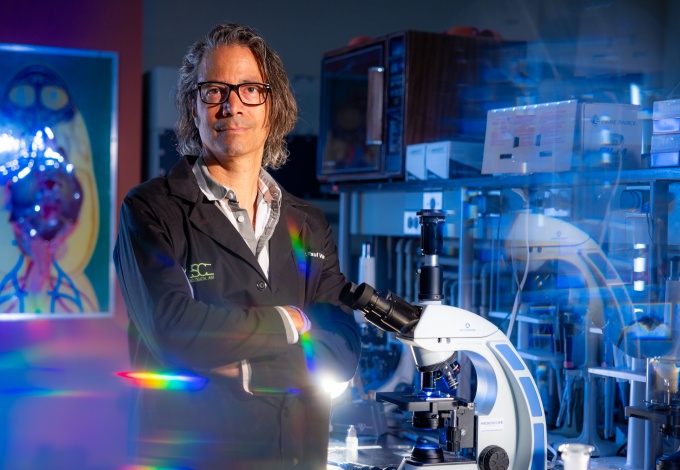
Paul Vanouse, SUNY Distinguished Professor of Art and director of the Coalesce Center for Biological Art, is a recipient of the Fulbright Tocqueville Distinguished Chair award. Vanouse will head to Paris in Spring, 2027 to fulfill the award’s mission to strengthen Franco-American collaboration in research and higher education. Photo: Douglas Levere
By VICKY SANTOS
Published June 2, 2026
Paul Vanouse, SUNY Distinguished Professor of Art and director of the Coalesce Center for Biological Art, will head to Paris in Spring 2027 after receiving a highly competitive Fulbright Tocqueville Distinguished Chair award.
The Fulbright Tocqueville Distinguished Chair program is designed to strengthen Franco-American collaboration in research and higher education. Recipients serve as guest scholars at French universities, where they conduct research, teach graduate and doctoral students, and participate in conferences and academic exchanges with French colleagues. The award is jointly funded by the French Ministry of Higher Education and Research and the Franco-American Fulbright Commission.
“They only give out two of these a year, so I was really, really pleased that I received one,” Vanouse said.
Since the early 1990s, Vanouse has created interdisciplinary artworks that use emerging technologies as artistic media to examine issues surrounding science, identity and institutional power. His current project, Utter, began during the COVID-19 pandemic and explores the relationship between speech, breath and viral transmission through a multisensory installation that simulates human breath using scientific glass apparatuses, scent and filtered biological materials.
Vanouse said the opportunity to collaborate on research for Utter began several years ago during an art-science workshop near Paris at École Polytechnique.
“I met a bunch of scientists there, and we hit it off right away,” Vanouse said.
Among them was Jean-Marc Chomaz, an atmospheric physicist working with aerosolized mists and experimental devices that respond to sound frequencies. Their conversations quickly evolved into ideas for future collaboration.
“I didn’t really know how scents were behaving in the air emitted by some of my olfactory pieces. Jean-Marc suggested I could come back and we could set up a laboratory to work on spatializing scents,” Vanouse explained.
That idea ultimately led Vanouse to apply for the Fulbright Tocqueville Distinguished Chair.
The installation examines the physical and emotional dimensions of human expression beyond spoken language.
“It’s this sort of system for generating artificially the characteristics of human utterance,” Vanouse said. “All the things that come out of our bodies that are pre-linguistic or non-linguistic — breathing, grunts, sighs.”
The work will feature interconnected scientific glass apparatuses filled with chemicals, microbes and reactive materials. Vanouse describes the installation as resembling a strange scientific instrument designed to explore how breath, sound and communication move through space.
The project first took shape during the COVID-19 pandemic, when ideas surrounding breath and airborne transmission became newly visible in everyday life. An invitation to create scientific glassware at Pilchuck Glass School in Seattle later helped transform the concept into a physical installation.
Vanouse also draws inspiration from Russian philosopher and linguist Mikhail Bakhtin, whose theories about language influenced the project’s title.
“An utterance is not simply a formal linguistic act between fixed speakers and listeners. Bakhtin argued that it may contain a polyphony of languages and dialects, modulated by inflections and intonations, from one culturally-situated subject awash in a sea of names, toward another subject likewise embedded, who may make meaning from it. Every utterance changes language itself,” Vanouse said. “Language is relational.
“In the spirit of Bakhtin, I’m hoping to further expand the scope of how we consider the utterance and the process of uttering, particularly the material aspects.”
In addition to research and exhibition work, the Fulbright appointment requires Vanouse to lecture throughout France and mentor graduate students through seminars and collaborative projects.
For Vanouse, the Fulbright offers international recognition and the opportunity to enhance a project that continues to evolve across disciplines and borders.