Synthesis


Where new molecules take shape
Synthetic chemistry at UB expands the molecular toolbox used to design bioactive compounds, functional materials and complex architectures. Through method development and precise molecular control, researchers create structures that enable new scientific and technological possibilities.
On this page:
Synthesis research addresses questions such as:
- How can new reactions and pathways be developed to create complex molecules?
- How can molecular structure be precisely controlled to achieve desired function?
- How can catalysts be designed to improve selectivity, efficiency and sustainability?
- How can synthetic methods produce bioactive and biomimetic molecules?
- How can nanoscale and supramolecular structures be reliably assembled?
Synthesis research combines reaction design, catalysis and molecular engineering to build new chemical structures. Researchers develop and apply synthetic methods to assemble organic, inorganic and hybrid systems with precise control over composition and architecture.
Work in this area includes metal-catalyzed reactions, chiral catalysis, controlled polymerizations and bioorthogonal chemistry. These approaches allow chemists to create molecules, macromolecules and nanoparticles tailored for specific functions.
Synthesis research at UB commonly includes:
- Organic and inorganic method development
- Metal-catalyzed and chiral reactions
- Bioactive and biomimetic molecule synthesis
- Functional macromolecules and polymers
- Nanoparticles, clusters and supramolecular assemblies
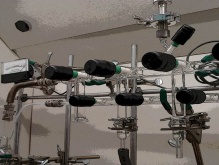

Students can gain hands-on research experience and build skills that translate to careers in pharmaceuticals, chemical manufacturing, materials science, catalysis, biotechnology and graduate study.