Published January 10, 2026
Professor Chen's drawings from walks along the Onguiaahra (Haudenosaunee) or Niagara River, to be shown at BAS
Buffalo Arts Studio presents Turbulence, by UB Art Professor Millie Chen.
On View January 23 – March 14, 2026
Opening Reception: Friday, January 23, 2026, 5:00 – 8:00 pm (Part of M&T Fourth Friday at Tri-Main)
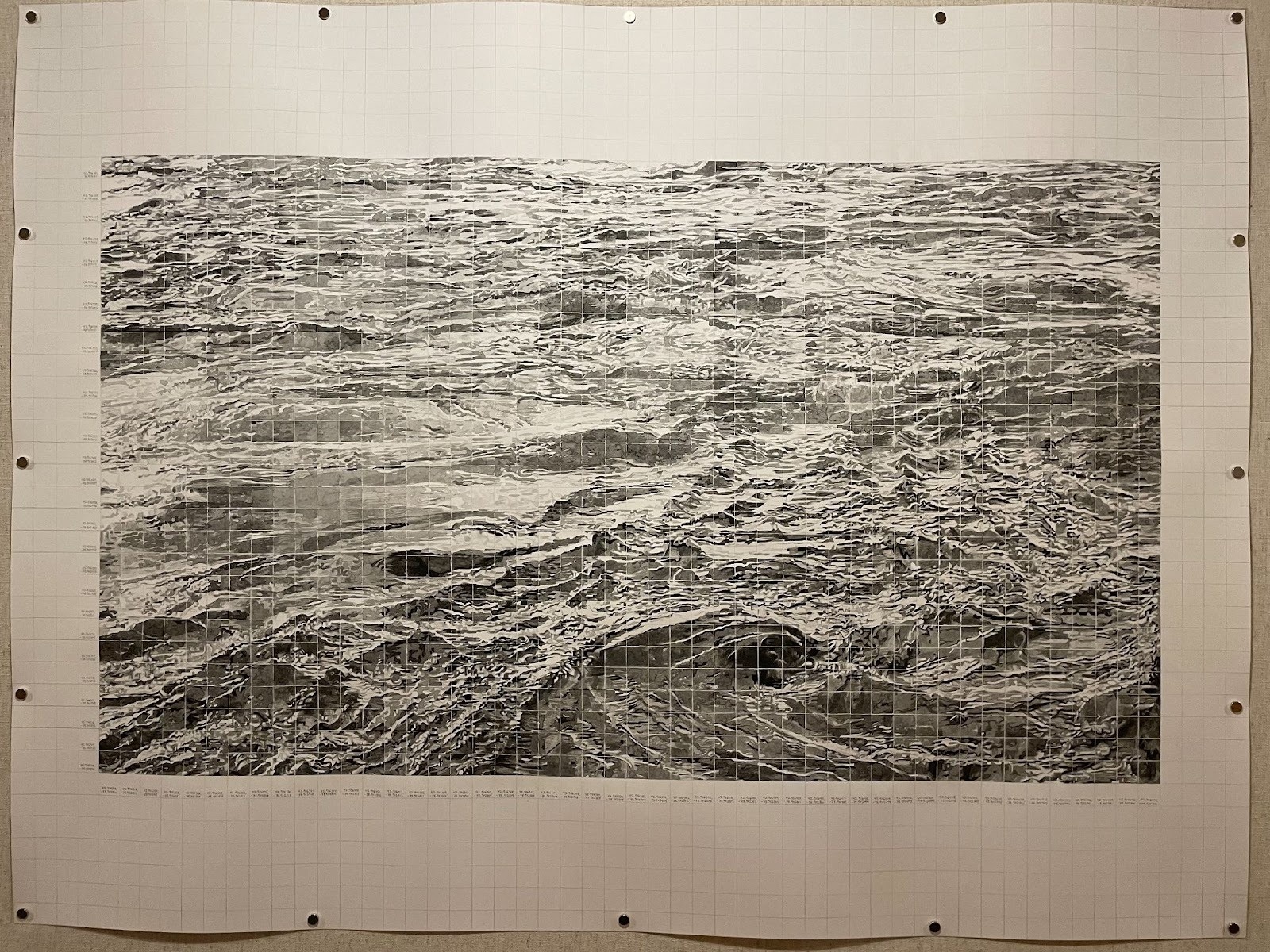
Millie Chen, Peace Bridge, 2024, photo courtesy of the artist
BAS Press Release
FOR IMMEDIATE RELEASE
Contact:
Buffalo Arts Studio
sydney@buffaloartsstudio.org
(716) 833-4450 x 114
www.buffaloartsstudio.org
Buffalo, NY — Buffalo Arts Studio is pleased to present Turbulence, a series of drawings by artist Millie Chen, on view from January 23 through March 14, 2026. An opening reception will be held on Friday, January 23, from 5:00 to 8:00 pm as part of M&T Fourth Friday at Tri-Main.
Turbulence refers to unsteady vortices, chaotic eddies, and other flow instabilities. It also describes moments of unrest, disruption, conflict, and resistance. In this exhibition, Chen contemplates the interrelationship of phenomena, history, social justice, and sorrow.
This new series of drawings emerges from years of Chen walking along both banks of the Onguiaahra (Haudenosaunee) or Niagara River and gazing in awe at its flow. These drawings focus on river sites that have historic and symbolic significance, embodied in the turbulence created by disturbances under the water's surface. Through her drawings, Chen lays out a historical tour that begins at the Peace Bridge. The Peace Bridge spans the Niagara River, connecting Fort Erie, Canada, to Buffalo, New York. During its construction, approximately 1.2 million artifacts dating back almost 11,000 years were unearthed, including Genesee spear heads and drills, Meadowood cache blades, Lamoka points, Haudenosaunee triangular points, Nanticoke notched points, and more. The Peace Bridge is on the traditional territory of the Attawandaron, the Haudenosaunee, and the Anishinaabeg, many of whom continue to live and work in the area. Chen alludes to this history by illustrating a particular instance of turbulence caused by the bridge’s current presence.
The historical tour continues down river, to and beyond Niagara Falls, telling stories along the way: of the ferry landings and former suspension bridge that facilitated the Underground Railroad; of the cultural and infrastructural reworking of Chippawa Creek (now the Welland River); of the peril beyond “the Deadline,” the Niagara River’s point-of-no-return leading towards Niagara Falls; of the historical portage site of Devil’s Hole; and of the indigenous and colonial military history behind Fort Mississauga. There is more to each of these sites, but even this limited narrative gives a sense of the turbulent history reflected in Chen’s work.
All of the drawings are linked by the use of grids. Chen harnesses the grid as a structural and theoretical device for creating complex, contemplative images, tapping into it as a powerful generative mechanism where each part and the whole are interconnected The grid is used to both retain and release control, embracing unpredictability and “errors” to express the uncertainty of being human. The rigid grid structure, paired with the unstable imagery, invites chance and intuition. This mix of qualities recalls the unruly nature of turbulence itself. Despite being studied exhaustively through fluid dynamics, the particular machinations of turbulence remain mysterious. While some instances are tangible enough as to their origin, others arise curiously and without a clear cause. The grids in Chen’s drawings grant a piecemeal order to the turbulence—fractured and unruly like the rapids and vortices that swirl within.
About the Artist
Millie Chen’s installations, videos, and interventions are intended as sensorial experiences that prod the perceptual and ideological assumptions of the audience. Her artwork has been shown across the U.S., Canada, China, Mexico, Brazil, France, Germany, the Netherlands, Northern Ireland, and Japan. Her work is in several public collections, and she has produced a number of major permanent public art commissions. Chen is a Professor in the Department of Art and Associate Dean in the College of Arts and Sciences, University at Buffalo, SUNY.
About Buffalo Arts Studio
Buffalo Arts Studio (BAS) connects diverse communities through visual arts, offering inclusive exhibitions, educational programs, mentorships, and public art initiatives. BAS provides vital resources for visual artists, including affordable studio space and paid opportunities. Through its programs, BAS serves as a catalyst for self-empowerment, innovation, and regional enhancement.
This exhibition is generously supported by The Cameron and Jane Baird Foundation, Community Foundation for Greater Buffalo, DownRoot Fund, part of the Crossroads Community Fund, Erie County Cultural Funds, M&T Bank, Ovation Stand for the Arts, The Andy Warhol Foundation for the Visual Arts, and through the New York State Council for the Arts with the support of Governor Kathy Hochul and the New York State Legislature.
Buffalo Arts Studio is located in Suite 500 of the Tri-Main Center at 2495 Main Street, Buffalo, NY 14214. For media inquiries, interview requests, or high-resolution images, please contact Sydney O’Shei at sydney@buffaloartsstudio.org or 716-833-4450 x 114.
---