2026 Art of Research Winner Kasturika Shankar

The University at Buffalo has announced the winners of the 2026 Art of Research competition. Selected works are on display at the Buffalo Museum of Science throughout May.

In the AI Research Unveiled category, Kasturika Shankar, a postdoctoral scholar in Biological Sciences, received recognition for "Patterns of Bias." The piece explores how artificial intelligence systems can reflect long-standing inequities in healthcare.

Shankar’s work examines how medical AI is trained on historical data shaped by gaps in research and treatment. These records often reflect patterns in which some groups have been studied and treated more than others. When used as a foundation for new technologies, this data can carry those imbalances forward.

The artwork visualizes this process through an abstract AI figure formed by streams of data from past patients. Some streams appear fragmented or muted, pointing to overlooked conditions and missing information, while others remain strong and continuous. The contrast shows how unequal data can shape the outcomes of emerging technologies.

"Patterns of Bias" invites viewers to consider how history informs innovation and how future systems might be designed with greater awareness and equity.
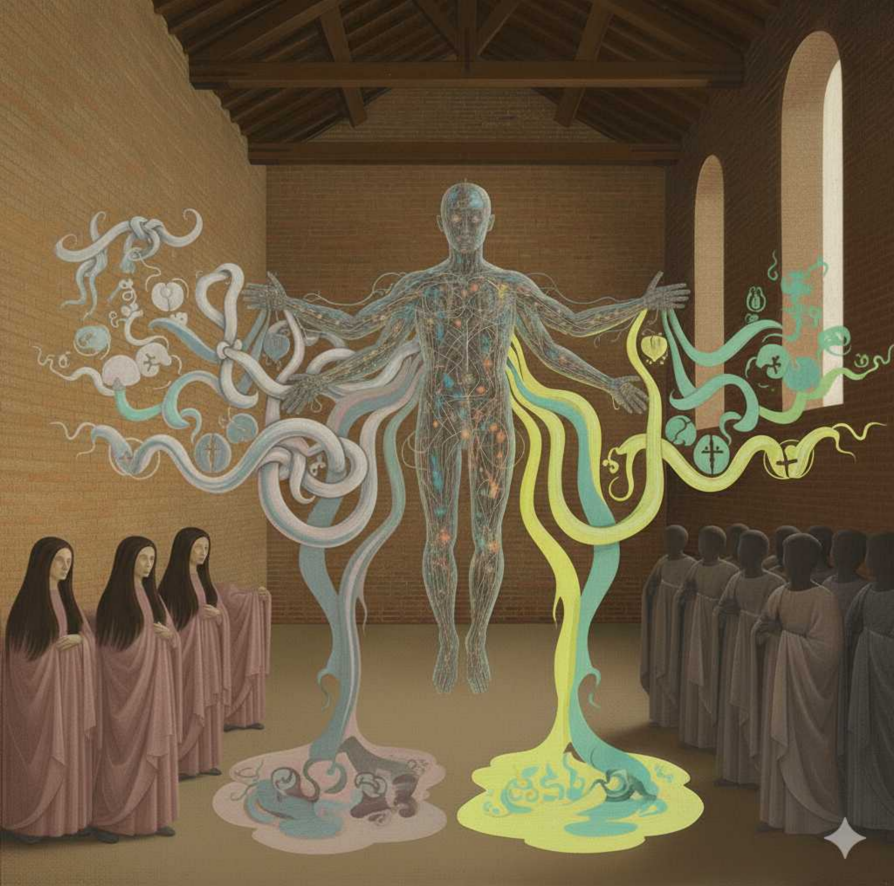
Zoom image: Patterns of Bias. (Credit: Kasturika Shankar). A stylized, symbolic illustration set inside a large, dimly lit hall with tall arched windows and a wooden ceiling. At the center, a human figure floats upright with arms extended outward, resembling a Vitruvian pose. The figure is semi-transparent and rendered with glowing, intricate lines and nodes, suggesting a network or nervous system. From both of the figure’s outstretched hands, flowing, ribbon-like forms extend outward in opposite directions. On the left side, the ribbons are pale, muted tones—whites, grays, and soft blues—and contain abstract shapes such as loops, organic forms, and small icons. These forms spill downward into a puddle-like mass on the floor. On the right side, the ribbons are brighter and more saturated—greens, yellows, and teals—and also contain abstract symbols and shapes. These too flow downward into a separate, more luminous puddle on the floor. On the left side of the room, a small group of human figures—appearing as women with long dark hair—stand together wearing long, soft pink robes. They face toward the central floating figure and the muted-toned ribbons. On the right side, a larger group of figures stands in shadow, wearing darker robes. They also face the central figure and the brighter-colored ribbons. The composition suggests a contrast or imbalance between the two sides, with the central figure acting as a source distributing different patterned outputs to each group.

Patterns of Bias. (Credit: Kasturika Shankar).