
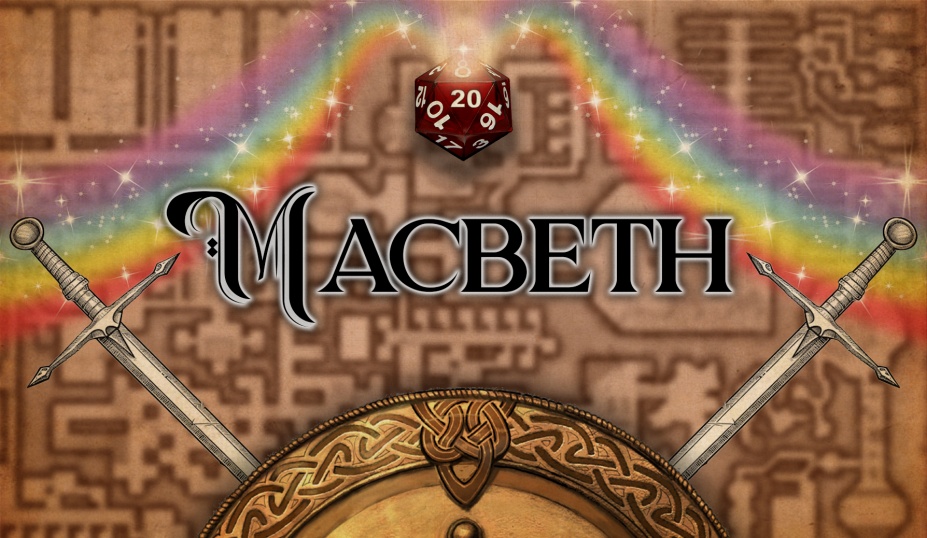
By William Shakespeare, adapted by Danielle Rosvally
UB Center for the Arts Drama Theatre
Mar. 5 at 7:30 p.m., Mar. 6 at 10 a.m. and 7:30 p.m.*, Mar. 7 at 7:30 p.m., Mar. 8 at 2:00 p.m.
Run Time and Intermission Info: 75 minutes with no intermission
Content Advisory: “Macbeth” contains graphic depictions of murder and violence, including war and infanticide. This production contains atmospheric effects, as well as moving, strobing, and flashing lights.
*Post‑show discussion featuring Guest Scholar Dr. Erika T. Lin from the CUNY Graduate Center.
Production Staff
Director/Fight Director: Dr. Danielle Rosvally
Asst. Director: Quest Sky Zeidler
Choreographer: Janet Werther
Dramaturgs: Val Fish, Christine Varnado
Cast
Hecate / Messenger / Servant / Murderer / Doctor: Zephyr Freeman
Witch 1 (Macduff): Piper Noda
Witch 2 (Lady Macbeth): Gabrielys Rosa Lozada
Witch 3 (Banquo): Madesen Clarke
Macbeth: Ty Burgess
Macduff: Jo Yanko
Lady Macbeth / Murderer / Soldier: Ainsley Urbanek
Banquo / Servant / Soldier: Nania Francis
Duncan / Murderer / Murderer / Soldier: Lóri Fejes
Malcolm / Messenger / Soldier: Madeline Dundon
Donalbaine / Murderer / Son / Soldier / Servant: Kendric Warrick
Captain / Fleance / Lady Macduff / Soldier / Servant: Casey Howe
Ross / Knife Guy / Soldier: Alex Fawkes
Lenox / Messenger / Soldier: Nneoma Ezeilo
THE VIDEOTAPING OR MAKING OF ELECTRONIC OR OTHER AUDIO AND/OR VISUAL RECORDINGS OF THIS PRODUCTION AND DISTRIBUTING RECORDINGS OR STREAMS IN ANY MEDIUM, INCLUDING THE INTERNET, IS STRICTLY PROHIBITED.
This performance will run approximately 75 minutes with no intermission.
DIRECTOR'S NOTE
Every year, the Human Rights Campaign (the nation’s largest LGBTQ+ civil rights organization) conducts a study to document and survey what life is like for LGBTQ+ people in the United States. In the third week of rehearsals, the findings from the 2025 survey were released, and it revealed a few very disturbing things. In the wake of concerted national-level legislative attacks on the LGBTQIA+ community, the survey found that acceptance of this community is eroding: “one in five U.S. adults (21.6%) say acceptance of LGBTQ+ people has declined in the past year. Three in ten (29.7%) LGBTQ+ adults share this belief” (HRC, 6). It found that outness is fading: “Nearly half (47.5% of LGBTQ+ adults report being less out somewhere in their lives over the last 12 months”(HRC, 6). It also found that visibility is slipping: “More than half of LGBTQ+ adults (51.1%) report being less visible than a year ago. 40.1% of LGBTQ+ parents with school-aged children report being less visible at schools, the highest of all measured environments” (HRC, 6).
I grew up in a house with Martin Niemöller’s poem framed on the wall, “First they came for the Communists, and I did not speak out because I was not a Communist…” History knows what happens when we allow marginalized people to become silenced. I can’t help but hear the poem in my head as I read these statistics, and fast forward to Niemöller’s ultimate chilling conclusion, “Then they came for me/And there was no one left/to speak out for me.” Remaining complacent both enables the suffering that silence brings, and also forfeits one’s own right to a voice when the world needs it most. That time is once again upon us.
Art is political. It always has been. Shakespeare, arguably the most influential English-language playwright, has been used by political agents since there was a Shakespeare to speak of. In 1601, Robert Deverux, the second Earl of Essex, attempted to seize power within the English court via a coup (this became known as the “Essex Rebellion”). In the days leading up to the rebellion, the Lord Chamberlain’s Men (Shakespeare’s theatre company) were paid substantial sums of money to perform Shakespeare’s Richard II, a play about a weakened English monarch being deposed. The would-be usurpers were caught and dealt with, and in the process Queen Elizabeth paid particular note to the role of Shakespeare’s story in this, famously asking her nobles: “I am Richard, know ye not that?”
Stories have power. Telling stories is the closest we can come to making real magic. Sharing stories with each other helps us feel something, en masse, together; it helps us grow in community and understand one another.
In 1937, John Ronald Reuel Tolkien published The Hobbit and in 1954 its sequel trilogy The Lord of the Rings. These four books, though certainly influenced by previous literature, are widely credited with inventing the genre of high fantasy. As a World War I veteran, Tolkien was intimate with the horrors of war. He was a staunch anti-industrialist, writing a race of tree people (the Ents) into his literary world, and a scene inspired by Macbeth where the Ents march to war (emulating Birnam wood approaching high Dunsinane hill). He was a feminist, advocating for women’s place in higher education and writing a scene in which a female soldier, Eowyn, defeats one of the biggest bads in Middle Earth while crying “I am no man” (inspired, again, by Macbeth and the fact that Macduff could subvert the witches’ prophecy that “no man of woman born can harm Macbeth” because “Macduff was from his mother’s womb untimely ripped”). He was anti-totalitarian. In 1938, Tolkien was in negotiations with German publishing house Rütten & Loening to publish a German-language edition of The Hobbit. The publishing house, undoubtedly to comply with Third Reich mandates, asked for proof of his “Aryan descent.” Tolkien responded (emphasis his): “If I am to understand that you are enquiring whether I am of Jewish origin, I can only reply that I regret that I appear to have no ancestors of that gifted people…. I have been accustomed… to regard my German name with pride…. I cannot, however, forbear to comment that if impertinent and irrelevant inquiries of this sort are to become the rule in matters of literature, then the time is not far distant when a German name will no longer be a source of pride.” We all know what happened next.
In 1974 Gary Gygax and Dave Arneson published the first edition of Dungeons and Dragons: one of the first and certainly the most lasting Table-Top Role-Playing Games (TTRPGs). TTRPGs allow a group of people to form community around a table and engage in collaborative storytelling. They have become a cornerstone of connection for vast swathes of nerds, geeks, freaks, rejects, storytellers, creatives, dreamers, and now: us. When history brings darkness, artists must bring light. The only cure for silence is loud, joyful noise. So here we are; loud and proud; ready to use our voices and tell this story.
Welcome to our table. Care to roll the dice?
Danielle Rosvally, Ph.D., Director
DRAMATURGE'S NOTE
“Something Wicked this way comes.” (Macbeth 4.1)
The Fates. The Heathers. The Powerpuff Girls. The Witches of Macbeth (also known as the
“Weird Sisters”), have created a precedent for the trio of powerful (traditionally female-identifying) characters who attempt to manipulate the story and ultimately cause chaos for everyone else in their path. The word “weird” in this case does not mean “strange or off-putting”, but instead refers to the witches’ ability to see the future and be agents of destiny rather than just being unearthly beings. This definition of “weird” comes from another trio traditionally depicted as female identifying entities: the Fates from Greek mythology. These characters are intimidating, they’re capable of seeing the future or some other form of supernatural power, and they have the ability to sway the outcome of their story for better or for worse. Whether they’re the most popular girls in school or misunderstood misfits, these trios rely on each other for support and are able to create power bigger than themselves when they’re together.
This dynamic is very similar to the idea of “found family” that’s often seen in queer spaces. Whether it’s fierce drag families or just a tight knit group of best friends, queer found families are based in a shared respect for one another and their identities, companionship, and belonging that may be lacking due to homophobia, racism, and other prejudices potentially inflicted by biological family units. In a political climate where being oneself (especially if one is queer) is something that needs to be fought for every single day, community is more important now than ever. Having a group of individuals that you can rely on through thick and thin and take you as you are has never been more valuable or empowering. This idea of groups built on identity and mutual care can be seen in queer media and history alike, from the ballroom “house” culture depicted in the pivotal documentary Paris is Burning, or the groups of heroes from works like The X Men comics, The Owl House, Steven Universe, or Our Flag Means Death.
In order to bring these two ideas together in our production of Macbeth, the trio of Weird Sisters become their own kind of found family. These wayward witches become a group of unabashedly queer individuals from across the gender and sexuality spectrum who share a love of expressing themselves as well as a passion for Dungeons and Dragons. The future is uncertain and the world outside seems bleak, but together they are able to be themselves and express their queerness without fear and also come together to tell the story how they’d like it to be told– and have it end the way they want. Through this found family bond, the witches are able to not only process the world around them in a safe environment, but are also able to heal and find a way forward through something that gives them joy.
In Macbeth, the witches are seen as omens of destiny, taunting Macbeth into making his wild grasp for ambition and glory and ultimately causing his downfall in the end. In this world that they’ve created for themselves, they are able to determine how it turns out in the end, and are also able to step into their power both as individuals and as a unit. As adventurers in the world of Dungeons and Dragons, these characters become fearless heroes trying to make right in an otherwise twisted and tyrannical world. The player characters (the righteous paladin Macduff, the clever bard Lady Macbeth, and the tactical but kind fighter Banquo, respectively) become avatars of change and progress as well as extensions of the witches– a channel through which they’re able to express not only their discontent, but also their triumph.
Val Fish, Dramaturge
PLOT SUMMARY
Amidst the political turmoil of 2026, three friends (or Witches) gather to escape through a game of Dungeons and Dragons with their dungeon master, Hecate.
In the world of the game, the Scottish army seizes victory against rebel forces thanks to the heroic exploits of Generals/Thanes Macbeth and Banquo. The duo encounters the Witches, who greet Macbeth with the title of Thane of Cawdor and prophesize that he shall be King of Scotland. Banquo, they predict, will “beget” a royal line.
Indeed, Macbeth soon learns that he has been appointed Thane of Cawdor. With this good news, Lady Macbeth hatches a plan for her husband to assassinate King Duncan so he can seize the throne. The couple dispatches their monarch, but Macbeth’s anxiety proves a serious liability. Fearing an attempt on their lives, princes Malcolm and Donalbain flee Scotland. Though Macbeth now rules as King of Scotland, he cannot rest easily. He sends murderers after Banquo and his son Fleance to abort the prophecy, and though they kill Banquo, Fleance escapes into the night.
At a royal banquet, Macbeth’s guilt manifests as a visitation from the ghost of Banquo, sowing doubt among his countrymen. To soothe his nerves, he seeks out the Witches once more, who deliver unto him further auguries: he should beware Macduff; that no man of woman born can harm him; and that he has nothing to fear until Birnam Wood travels to his castle on Dunsinane Hill. To circumvent the Witches’ warnings, Macbeth sends assassins after Macduff and his family. Macduff, however, has left for England to convince Malcolm to return to his homeland with armed forces to overthrow the tyrannical Macbeth.
Lady Macbeth has become untethered from reality, tortured by the memories of her misdeeds. The loyalist forces approach Dunsinane holding branches, creating the illusion that Birnam Wood is approaching Macbeth’s stronghold. When Macbeth learns that his wife has died, he finds himself facing the inevitable. His forces face off against the loyalist army, until Macbeth comes face to face with the avenging Macduff. Macduff reveals that he was brought into the world via a caesarian section, “not of woman born.” He slays Macbeth, bringing an end to his reign of terror.
Back in the real world, the Witches and Hecate celebrate the defeat of the “Big Bad” in their D&D campaign, sharing a moment of solace, togetherness, and empowerment.
Quest Sky Zeidler, Assistant Director
UB THEATRE AND DANCE 2025-2026 BOOSTERS
Janeen Cole
Meredith Conti
Cynthia Darling
Michael Deeb Weaver
Kate DeRosa
Jeanne Fornarola
Stephanie Genco Gasiecki
Glenda Hastings
Lynne Koscielniak
Vincent Koscielniak
Rion and Julie Cohn Kweller
Eero Laine
Julia Krieter
Paul Liguori
Thomas Mitchell
Elise Pearlman May
Nicholas Quinn
Thomas Ralabate
Jessica Rezin
Kerry Ring
Neil Shanahan
Stanley Urbanek
Support UB Theatre and Dance’s students as they conduct innovative creative research and train for careers in the performing arts and entertainment industries. BECOME A UB THEATRE AND DANCE BOOSTER!
MEET THE PRODUCTION TEAM, CAST AND DESIGN/TECH COLLABORATORS
Danielle Rosvally, Ph.D. (Director / Fight Director) has spent most of her life thinking about Shakespeare, and the rest of it thinking about fantasy literature. She is the author of Yassified Shakespeare: Gender Performance and Critical ShaxDrag (Bloomsbury Arden Shakespeare, 2026) and Theatres of Value: Buying and Selling Shakespeare in Nineteenth-Century New York City (SUNY Press, 2025). Her directing has been seen here at UB: Henry VI ii, 2024; Twelfth Night, 2021; Julius Caesar, 2019. Her fight direction has been seen regionally across the Northeast, most recently in Buffalo at Irish Classical Theatre Company’s A Skull in Connemara (2026), Or (2025), Dorian (2025), and The Loved Ones (2025). In 2025, Danielle became the first fight director ever to be nominated for an Artie Award by Buffalo Toronto Public Media for her work on Dorian.
Quest Sky Zeidler (Assistant Director) is a PhD student in Theatre and Performance, director, and performer. He earned his BA and MA at UC Santa Cruz, where he directed productions of Lion in the Streets by Judith Thompson, Woyzeck by Georg Büchner, among others, and founded Loose Lips: A Lipsynch Cabaret. His chapter “Revenge of the Monster Queer” is now available in the edited volume Monstrous Utopias. He cohosts the podcast Ghosts Were People Too, which haunts whichever platform you prefer. He performs in the local Buffalo drag scene under the name Count Twinkula (@bramstokerstwinkula on Instagram). http://questskyzeidler.com
Dr. Janet Werther (Choreographer) (they/them) is an artist/scholar who works at the intersections of queer and feminist performance history, theory, and practice. Their work as a director, choreographer, and movement dramaturg prioritizes embodied storytelling and empowered relations to oneself and one's communities. Dr. J holds a BA in Dance from the University at Buffalo, an MFA in Dance & Choreography from Sarah Lawrence College, and a PhD in Theatre & Performance from The Graduate Center, CUNY. They performed professionally with The Ballez Company from 2013 to 2017, originating the role of Little Red Riding Hood in The Ballez's Sleeping Beauty and the Beast at La Mama, ETC in 2016. Dr. J is proud to teach at their undergraduate alma mater. Their book-in-progress about queer/feminist performance histories of adaptation is entitled Dyke Dramas, and they're also writing an immersive, sensory-friendly adaptation of Voyage to the Bunny Planet by Rosemary Wells for young audiences of all neurotypes.
Lindsay Brandon Hunter (Intimacy Director) is an actor, intimacy specialist, and associate professor in UB’s Department of Theatre and Dance. Locally she has performed with theatres like the D’Youville Kavinoky (What The Constitution Means to Me) and Alleyway (Death of a Streetcar Named Virginia Woolf), and regionally with Annex Theatre, Book-it Repertory (Seattle), Vector Theatre Company (San Francisco), the Asolo Repertory Theatre (Sarasota), and the New York Neo-Futurists, where she was a founding ensemble member of the current company. She has been a proud member of Actors Equity since 2005.
Val Fish (Dramaturg) is overjoyed to be making their UB dramaturgy debut with Macbeth! They are a first year master's student in theatre and performance studies. Special thanks to Danielle for the fantastic opportunity and enjoy the show!
Christine Varnado (Dramaturg) teaches queer and trans theory, Shakespeare, and early modern literature in the departments of Global Gender & Sexuality Studies and English at UB. Her first book, The Shapes of Fancy: Reading for Queer Desire in Early Modern Literature (2020), is open access on the University of Minnesota Press website. She is at work on a book about Macbeth, abortion, infanticide, literary character, what counts as a child, and who counts as human. Always down to talk about witches and dead ghost babies.
Zephyr Freeman (Hecate / Messenger / Servant / Murderer / Doctor) is a freshman MT BFA student making their UB debut! They have loved to act since they were a little kid, and love to play DnD with their friends. This is their first time ever being a DM and now they have a lot more respect for all the DM’s out there. This cast has been so much fun and the whole tech team is outstanding, this has been so much fun! To my family, thank you for supporting my dream. To my friends, thank you for showing up.
Piper Noda (Witch 1 - Macduff) (she/they) is a freshman BFA student in the MT program at UB. She hails from Cleveland, Ohio. This is her first show at UB. Prior to this, her favorite roles were Annabeth in The Lightning Thief, Olive in Spelling Bee and Mary in Merrily We Roll Along. In her free time she enjoys D&D, animating, softball, archery, and aikido. She would like to thank her parents for driving some of her home D&D crew in for the show. Enjoy the show everyone!
Gabrielys Rosa Lozada (Witch 2 – Lady Macbeth) is a freshman Music Theater major. She is so excited to be making her debut at the University at Buffalo as Witch #2. She would like to thank all the cast, crew, and creative team for making her first rehearsal process at UB exciting. She hopes you all enjoy the show!
Madesen Clarke (Witch 3 - Banquo) is thrilled to make her onstage debut at the University at Buffalo in Macbeth. She previously worked as stage crew for UB’s 2025 production of Urinetown, where she first stepped into the compelling world that is theatre at UB. Having first performed Macbeth in high school, Madesen is extremely grateful to revisit the Shakespearean literary work in this spellbinding UB adaptation. Now ready to conjure up some more chaos as Witch 3, she’d like to give a wicked shoutout to her fellow witches, cast and crew for constantly serving looks, vibes, and, of course, the hive mind. She’s thankfully rolled a 20 and has had the most wonderful time collaborating with such a compassionate cast and crew. She can't help but feel forever grateful that this production marks the beginning of what she hopes to be many more performances at UB. ⋆˙⟡
Ty Burgess (Macbeth) (he/they) is an actor and playwright based out of the Buffalo area. He is a junior, currently pursuing an Acting BFA at University at Buffalo. Some recent productions he’s been involved in at UB include Urinetown (Hot Blades Harry), Shakespeare Showcase (co-director), and Pajama Game (Vernon Hines). Playing Macbeth has been such an illuminating experience, and he is so thrilled to be able to share it with an audience. He would like to thank every person involved in making this production possible. As well as his professors, friends, and family giving him support and guidance throughout this process.
Jo Yanko (Macduff) is a junior Theatre (B.A.) major at the University at Buffalo, and is so excited to be returning to Shakespeare with Macbeth. Previous U.B. credits include Three Sisters (Chebutykin), Chamber Music (Director, “Woman in Queenly Spanish Garb”), The Wolves (#25). They would like to thank their fellow castmates and the wonderful crew for being beyond delightful to work with, their friends and family for existing on the same planet at the same time as them, and Carye Persico, for being the greatest person in the world.
Ainsley Urbanek (Lady Macbeth / Murderer / Soldier) (she/her) - is so excited to be making her UB mainstage debut in Macbeth! She is a freshman pursuing her BFA in Musical Theatre at the University at Buffalo. Some of her previous credits include Antigone (Antigone), Summer and Smoke (Nellie Ewell) and Grease (Sandy). This is her first Shakespeare production and she has fallen in love with the language, artistry and style. She would like to thank her professors, her family, and her friends for the immense support, and an extra big thank you to her loving cast and team, who has made her feel so encouraged and cared for.
Nania Francis (Banquo / Servant / Soldier) is a freshman at the University at Buffalo, where she majors in Music Theatre with a minor in Dance. Macbeth will be her first show here at UB, which she is excited about. She looks forward to the growth she will experience in herself as an artist and as a person.
Lóri Fejes (Duncan / Murderer / Soldier) (he/him) is a graduate student in the department of Theatre & Dance. He is excited to return to acting after a long hiatus and remains grateful for the patience and support of the Macbeth cast and team, including dramaturg Val, who encouraged him to audition.
Madeline Dundon (Malcolm / Messenger / Soldier) (she/her) is a freshman double major in Acting (BFA) / Theatre (BA), and she is so excited to make her UB mainstage debut! Some of her past credits include: Twelfth Night (Viola), How to Succeed in Business Without Really Trying (Gatch), The Heidi Chronicles (Lisa), and the UB Shakespeare Showcase. She would like to thank her family and friends, the Macbeth team, and, of course, her amazing castmates for making her first UB show such a beautiful and fulfilling experience!
Kendric Warrick (Fight Captain & Donalbaine / Murderer / Son / Soldier / Servant) is a 19-year old Actor, Dancer, and Singer based in Buffalo NY, and a BFA Music Theater and BA Dance Major at the University at Buffalo. He’s been cast in many shows in Western New York and recently made his Buffalo debut as of the 2025-2026 season of Shea’s 710 , starring in Dreamgirls, Mamma Mia!, and Hairspray. He hopes to grow as a performer, teacher, and person, navigating his career.
Casey Howe (Captain / Fleance / Lady Macduff / Soldier / Servant) is so excited to be making her UB debut with the cast of Macbeth! She is a first year Music Theater major with a double minor in dance and sociology from Rochester, New York. Past favorite roles include Donna (Mamma Mia), Hope Cladwell (Urinetown) and Plankton (SpongeBob the Musical). She would like to thank her castmates and directing team for putting together such a fantastic show, their endless support and keeping her sane during 10pm rehearsals. Enjoy!
Alex Fawkes (Ross / Knife Guy / Soldier) (He/they) is a latinx senior Theatre Performance BFA major at UB. This will be their last play at UB. Previous acting credits include Puffs, Three Sisters, The Intruder, C'est La Vie, Wasting Away, Almost Maine, The Pajama Game, Beauty and the Beast, Newsies and Aladdin. Other credits include WBFO radio's The Legend of Sleepy Hollow (voice), A Crack in the Egg (Stage Manager), Urinetown (ASM), Mr. Burns (RASM/Head Dresser) and most recently, In The End of Times (Playwright/Director/Sound, Lights & Set Designer). They hope you enjoy this D&D rendition of the Scottish Play! You can follow him @rigel_fawkes.
Nneoma Ezeilo (Lenox / Messenger / Soldier) is a senior Nuclear Medicine Technology student. This is Nneoma’s first role in any production.
Evelyn McLaughlin (Stage Manager) is an emerging designer/manager pursuing a BFA in Theatre Design/Technology in the University at Buffalo’s Department of Theatre and Dance, where she recently served as assistant lighting designer for Urinetown. She previously stage managed award‑winning productions at the Shubert High School Theatre Festival, including Titanic (2024) and Sweeney Todd (2025), and studied theatre preservation as an intern with Broadway’s Shubert Organization. Evelyn also works as a stagehand with IATSE Local 10 and strives to create theatre that strengthens community through compassion and connection.
Allie Space (Assistant Stage Manager) is a freshman Theatre Design and Technology student working on their third production at UB. They give their thanks to the amazing cast and SM team that they worked with the last few weeks for making the hours bearable and joyful!
Lyla Wasilewski (Assistant Stage Manager) is a freshman Theater Studies BA student who is excited to be taking on new opportunities in her collegiate theater experience. She would like to thank her family and friends for their continuous support, as well as Lynn Koscielniak and Ally Hasselback for entrusting her with this position. She feels extremely grateful to have worked with a phenomenal cast and crew on this production.
Dylan McGannon (Technical Director) is a senior Theatre BA with a concentration in design technology student. He is also on the UB Cheer team. He thanks his fellow students that helped build the set and learn so much along the way. He is also extremely grateful to his family and friends for their constant support and interest in his, sometimes crazy, endeavors. Special thanks to Erich Frank for their mentorship.
Maili Novak (Set Designer) is currently a junior design/tech BFA. Most recently at UB she was the Stage Manager and Assistant Technical Director on Urinetown. She is excited to be tackling scenic work from the design side this semester. She would like to thank the entire design team for an amazing creative process, and her mentor Marc Quattlebaum for the support in fighting drafting softwares. This one is for everyone in her family who was skeptical when she announced at 5 years old that she was going to build a castle when she grows up.
Sophia Larish (Costume Designer) is a Junior Theater BA and the Costume Designer for Macbeth. Sophia brings her background in Theater and Dance Performance into her technical practices here at UB in both Stage Management and Costuming. Previous credits include, Outrage (ASM), Mr. Burns: A Post Electric Play (SM), Fabulation (ASM), Fefu and Her Friends (SM), Emerging Choreographers Showcase (SM), and Urinetown (Draper.) Upcoming credits include MFA Dance Showcase (SM), and Into the Woods (Draper.) Sophia would like to thank the amazing costume shop team for all of their help and hard work!
Em Puffer (Assistant Costume Designer / Wardrobe Head) (They/he) is a Political Science and Theatre BA double major, who has had an interest in costuming since they were young-- with a special interest in hair and makeup as political expression, and as an art form. Em was involved in theatre costuming during their high school years, and now in college they have worked as a Wig Styling Assistant on Pajama Game (UB Spring ‘25), Hair and Makeup Supervisor on Urinetown (UB Fall ‘25), and most recently as Hair and Makeup Designer for the UB Spring ‘26 Production Season.
Ashtyn Rozenberg (Lighting Designer) (they/them) is a lighting designer, lighting programmer and theatre electrician. Production work for the University at Buffalo Department of Theatre and Dance includes lighting designer on Macbeth and Choreographers Showcase, and lighting technician for Zodiaque Dance Company Celebration 50 Program and Urinetown.
Chris Ochman (Head Theatre Electrician / Light Board Programmer and Operator)
Lisa Gallagher (Sound and Media Designer) is a senior Theatre Design/Technology student at the University at Buffalo. As a theatrical designer and technician, Lisa has worked in audio, lighting, scenery, video, and stage management. Last year, Lisa had the honor of attending the American College Theatre Festival's National Conference as a Sound Design Finalist, where she won the Eugene O'Neill Theater Center Audio Fellowship. She is excited to sound design once again for UB’s production of Macbeth. Enjoy the show!
Phoenix Hall (Props Designer) (they/them) is the Props designer for Macbeth, pursuing a Theatre BA and a Mathematics BA. They’ve previously worked as head electrician on The Wolves, and head carpenter on Urinetown. Future positions include head electrician for Into The Woods.
Faith Marsala (Puppet Designer) is in her senior year as a BFA Theatre Design/ Tech student. Most recently, she costume designed for Urinetown last fall. She has stage managed Fabulation and ChoreoLab and has been involved in many productions in her time here. She is extremely grateful to Marc Quattlebaum for his mentorship during this design process. She would like to thank the company and crew for making her designs come to life. Finally, she gives a special thanks to her parents for supporting her throughout her college career. She hopes everyone enjoys the University at Buffalo’s production of Macbeth!
Kaitlyn Ball (Head Carpenter) comes from California to pursue a Bachelor's in Fine Arts degree in Theatre Design/Technology.
Sara Goldschmidt (Scenic Artist) is currently a junior design/tech BA at the University at Buffalo. Sara has worked as props manager on UBs production of The Wolves and Urinetown and is excited to be working as scenic artist on this season's production of Macbeth and as assistant costume designer on Into the Woods. She would like to thank her mentor Marc Quattlebaum for his expertise and guidance. She is excited to continue building her resume at UB and continue working with the amazing and talented people in the theatre department.
Design/Tech Mentors
Tom Burke, Cindy Darling, Erich Frank, Ally Hasselback, Lynne Koscielniak, Max Levitt, J. Marc Quattlebaum, Nick Quinn
Design/Tech Student Collaborators
Stage Manager: Evelyn McLaughlin
Asst. Stage Managers: Allie Space, Lyla Wasilewski
Technical Director: Dylan McGannon
Set Designer: Maili Novak
Costume Designer: Sophia Larish
Asst. Costume Designer: Em Puffer
Lighting Designer: Ashtyn Rozenberg
Head Theatre Electrician/Light Board Programmer and Op: Chris Ochman
Sound and Media Designer: Lisa Gallagher
Props Designer: Phoenix Hall
Puppet Designer: Faith Marsala
Head Carpenter: Kaitlyn Ball
Scenic Artist: Sara Goldschmidt
Crew
Deck Head/Armorer: Hannah D’Elia
Fly and Deck Crew: Jacari Bennett, Justin Lapidus, Kyla Thomas (Captain)
Props and Deck Crew: Abby Cabrera
Dressers and Makeup Crew: Lillian Rothrum, Jess Vriesen (Supervisor)
QLab Sound/Media Operator: Danielle Sapor
Sound Mixer: Leo Muck
Department‑Wide Student Production Contributors
Production Stage Managers: Liam Deyell, Faith Marsala
Scenic Artist: Sheila Fastoff
Properties Director: Elle Dixon
Head Theatrical Electrician: Ash Ferguson
Theatrical Electricians: Thomas Eikel, Leo Muck
Information Technologist: Koby Fallon
Hair and Makeup Technician: Em Puffer
Costume Drapers: Angel Frias Fuertes, Sophia Larish
Costume Shop Assistants: Sophia Brito, Olivia Ehmke, Kay O’Sullivan, Allie Space, Kyla Thomas, Emilia Vischi
Center for the Arts Professional Staff Collaborators
Technical Director: John Saunders
Head Electricians: Anthony Rajewski, Patty Rihn
Theatre and Dance Administration and Technical Staff
Chair/Artistic Director: Meredith Conti
Associate Chair/Producing Director: Lynne Koscielniak
Department Administrator: Veronica Sedota
Senior Staff Assistant: Rob Falgiano '93
Administrative Assistant: Kristin Mann
Technical Director: Nick Quinn
Production Manager: Ally Hasselback
Assistant Technical Directors: Tom Burke, Erich Frank
Scenic Artist and Head of Stage Properties: J. Marc Quattlebaum
Scene Shop Instructional Support: Hannah D’Elia
Costume Shop Manager: Max Levitt
Assistant Costume Shop Manager: Cindy Darling
Costume Shop Assistant: Judith Curtis
Production Photographer: Eric Tronolone

This production is registered as an Associate Production in the Region 2 American College Theater Festival Program.








Season Dedication
The UB Department of Theatre and Dance is honored to dedicate its 2025–2026 production season to the memory of Professors Emeriti Saul Elkin and Vincent O’Neill, in recognition of their extraordinary contributions to the field of theatre and to our academic and artistic community.
Throughout their distinguished careers, Professors Elkin and O’Neill exemplified excellence in education, direction, and performance. Their
visionary leadership and steadfast commitment to the transformative power of theatre have shaped generations of artists and scholars, leaving a legacy that continues to inspire.
Acknowledgements and Sponsors
The UB Department of Theatre and Dance is a proud member of the UB College of Arts and Sciences.
With a firm commitment to the advancement of creative research, experiential learning, and community engagement, the UBTHD 2025-2026 Production Season is administered by the Department of Theatre and Dance. We acknowledge our full faculty and staff for their part in preparing students for work on stage and behind the scenes.
We thank UB Center for the Arts for their support in making these productions possible.
UB Theatre and Dance wishes to acknowledge the generous continued philanthropic support of Fox Run at Orchard Park, an official contributing sponsor of the UBTHD 2025-2026 season.
Special Thanks To:
- University at Buffalo Humanities Institute Performance Research Working Group and University at Buffalo Humanities Institute Queer Studies Research Working Group for funding our guest speaker series.
- Erika Lin for work as our guest speaker.
- Troy Coleman and Janet Werther for fight choreography assistance.
- Hannah D’elia, Michael Fenton, and Max Levitt for DMing our cast and crew D&D one-shot
- Jeanne, Andy, and Drew Fornarola for use of their invention of rolling music stands during our rehearsals.

