2025-26 | These Toxic Times
Toxicity, a word rich in material and metaphorical implications, is the launching point of this year’s UB Humanities Institute Annual Conference taking place March 10-11, 2026. We invite you to join us as we, together, seek to unravel the complications, politics, histories, and practices surrounding “toxicity,” while drawing attention to the many ways we can, must—and do—carry on in toxic times.
What counts as toxic?
Pesticides, PFAS chemicals, and unregulated industrial waste are certainly “toxic.” Masculinities, personalities, and workplaces are now often described the same way.
As a term, "toxic" identifies material threats to bodies and environments. Yet we now also regularly confer its metaphorical use on affective atmospheres and situations. The accelerating scope of toxicity's meaning suggests that its interpretation ultimately rests in conditions of power: the power to create and to violate as well as to maintain or repair breached borders.
As a multi-day conference, “These Toxic Times” will examine responses to environmental poisons alongside the multi-faceted effects of our metaphors. The aim of the scholars, artists and activists who will share their work isn’t to restore “toxicity” to any perceived unity or integrity of meaning, but to address the complications and politics, histories and practices surrounding the term “toxicity,” while drawing attention to the many ways we can, must—and do—live alongside the toxic in both ordinary and extraordinary encounters.


Times & Locations
Tuesday, March 10 | 8:30 a.m. - 5:00 p.m. | Conference Day 1
Student Union Landmark Room (210 SU)
Wednesday, March 11 | 10:00 a.m. - 6:30 p.m. | Conference Day 2
Locations: Student Union Landmark Room (210 SU) and Center for the Arts Screening Room (112 CFA)
Add-On Day: Thursday, March 12 | 9:00 a.m. - 1:00 p.m. | Bus tour of Love Canal guided by Luella Kenny
Bus departs from the Center for the Arts loop. Space limited to the first 35 registrants.
Related Events
Ongoing | Toxic Archives: Voice from Love Canal
Silverman Library (3rd floor Capen)
Mon., Mar. 2 | 6:00 p.m. | PLASMA Speaker Series: Jason Corwin
Center for the Arts Screening Room (112 CFA)
Mon., Mar. 9 | 7:00 p.m. | Film Screening: Une île et une nuit/An Island and One Night, (2021-23, 1 hr 40 mins.) a film by Pirates des Lentillères
Burning Books (420 Connecticut St.) organized by Alexis Shotwell
Thurs., Mar. 12 | 6:00 p.m. | UB HI Science in Society Research Workshop presents Fernando Domínguez Rubio, "Avowing Loss"
Hallwalls Contemporary Arts Center (341 Delaware Ave.)
The Humanities Institute, a unit of the College of Arts and Sciences, gratefully acknowledges our partners and sponsors:
Tuesday, March 10 | Day 1

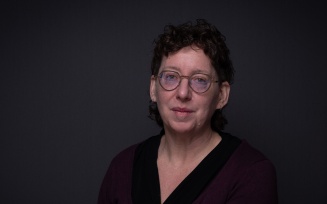
Keynote Speaker: Alexis Shotwell, Carleton University
Alexis Shotwell is a professor at Carleton University. Her academic work addresses impurity, environmental justice, racial formation, disability, unspeakable and unspoken knowledge, sexuality, gender, and political transformation.
Taking complicity and compromise as the constitutive and collective circumstances of our lives, rather than as things we can avoid, her current projects investigate how we might understand, bear witness, and respond to unjust histories and complex presents with an eye toward creating different futures.
Shotwell is currently writing and publishing on how speculative fiction connects with collective ecological movements and practices of direct democracy, with a manuscript in progress about Ursula K. Le Guin’s anarchist environmentalism. She is the author of Knowing Otherwise: Race, Gender, and Implicit Understanding (Penn State Press, 2011), Against Purity: Living Ethically in Compromised Times (Minnesota University Press, 2016), and Liberation is Other People (Minnesota University Press, in production, forthcoming 2026).
Location: Student Union Landmark Room (210 Student Union) | Link to map
Wednesday, March 11 | Day 2

Featured Event: "Fighting for a Toxic-Free World: A Conversation with Professor John Fiege and Mike Schade of Toxic-Free Future"
Join us as Media Study Professor John Fiege interviews Mike Schade of Toxic-Free Future live on-stage for the Chrysalis podcast. In this wide-ranging conversation, they will explore Mike’s experiences over decades campaigning to reduce plastics and eliminate toxic chemicals including PFAS. Fiege and Schade will discuss working for a toxic-free world now and in the future. They will consider what role students can play in securing a healthier tomorrow.
Presented in partnership with the Humanities Institute Spring Conference “These Toxic Times,” this event is part of the University at Buffalo Archives exhibition and programming series on Love Canal and environmental justice.
This event will include a pre-interview reception in the Center for the Arts atrium beginning at 3:30 p.m.
Location: Center for the Arts Screening Room (112 CFA) and live-stream on YouTube


Click on the visiting speaker's name to learn more about them.
Tuesday, March 10
Location: Student Union Landmark Room (210 Student Union) | Link to map
8:30 a.m. | Check-in (complimentary breakfast)
8:45 a.m. | Welcome and Introductions
- Christina Milletti, Interim Director, UB Humanities Institute and Associate Professor, English
- Jeff Grabill, Dean, UB College of Arts and Sciences
- Elizabeth Mazzolini, Conference Convener, Associate Professor, English
9:00 a.m. | Session 1: Experience
A Decade After Standing Rock: Reflections on Pipeline Movements, State Power, and the Health Effects of Oil and Gas Development
- Jason Corwin, Clinical Assistant Professor, UB Indigenous Studies
- Kirk Jalbert, Associate Professor, UB Environment and Sustainability
- Shannon Seneca, Research Assistant Professor, UB Indigenous Studies
10:45 a.m. | Break
11:00 a.m. | Session 2: Emergence
- Gayathri Goel, Visiting Assistant Professor, Core Curriculum, Boston College, "Toxic Purities and Intoxicating Revolts: Cannabis as Resistance in Michelle Cliff's No Telephone to Heaven"
- David Herzberg, Professor, UB History and Director of the Drugs, Health, and Society Program, "U.S. drug market segregation and the emergence of ‘the addict’"
- Olga Kuchinskaya, Associate Professor, Communications, University of Pittsburgh, "Mediatization of Risk"
12:45 p.m. | Lunch (provided)
1:30 p.m. | Session 3: Environment
- Marisa Manhein, Assistant Professor, UB Environment and Sustainability
- Laura Marris, Visiting Assistant Professor, UB English, “Reading the Ground Truth: Local Places as Archives of Ecological Memory”
- Saguna Shankar, Assistant Professor, UB Information Science
3:15 p.m. | Break
3:30 p.m. | Keynote by Alexis Shotwell, "Working with Toxicity: Disability, Pace, and Anti-Productivism"
Introduction by Andrea Pitts, Interim Executive Director, UB Humanities Institute and Associate Professor, Comparative Literature and Global Gender and Sexuality Studies
Day 1 | End
Wednesday, March 11
Locations (see detailed schedule below):
- Silverman Library (3rd floor Capen)
- Student Union Landmark Room (210 Student Union) | Link to map
- Center for the Arts - Atrium and Screening Room
10:00 a.m. | Guided exhibit tour of "Toxic Archives: Voices from Love Canal"
Join us in the Silverman Library (3rd floor Capen) for a guided tour of the current UB Archives exhibit "Toxic Archives: Voices from Love Canal" led by University Archivist Hope Dunbar.
10:45 a.m. | Check-In (complimentary coffee and snacks)
Student Union Landmark Room (210 SU)
11:15 a.m. | Welcome and Introductions
- Welcome by Christina Milletti, Interim Director, UB Humanities Institute and Associate Professor, English
- Introductions by Elizabeth Mazzolini, Conference Convener, Associate Professor, English
11:30 a.m. | Session 1: Embodiment
- Jill Gatlin, College Faculty, Liberal Arts, New England Conservatory, "U.S. Toxic Nationalism, Dismissal, and Disturbance in Simon & Schuster’s Reading Group Guide to Indra Sinha’s Animal’s People"
- Casey Ryan Kelly, Professor, Communication Studies, University of Nebraska-Lincoln, "Bro-science and Fitness Nationalism"
- Jayson M. Porter, Assistant Professor, History, University of Maryland, College Park, "Whiteness as Evidence of Cleanliness: Soap and the Racial Science of Saponification"
1:15 p.m. | Lunch (provided)
2:00 p.m. | Session 2: Enormity
- Shannon Dowd, Associate Professor of Spanish, Modern and Classical Languages, Niagara University, "Ammonia to Zyklon-B: Labatut’s Toxic Fiction"
- Jenny Rice, Professor, Writing, Rhetoric, and Digital Studies, University of Kentucky, “Operation INFEKTION"
- Elia Vargas, Visiting Assistant Professor, UB Media Study
3:30 p.m. | These Toxic Times: A Pop-Up Art Exhibit - Viewing and Reception in Center for the Arts
Center for the Arts Atrium | Link to map
These Toxic Times: A Pop-Up Exhibition of Works by Chantal Calato and Joan Linder
Center for the Arts Atrium | 3:30 p.m. - 4:30 p.m.
Please join us for a reception and viewing of artworks by:
- Chantal Calato, artist
- Joan Linder, artist and Professor, UB Art
Beverages and heavy snacks will be served.
4:30 p.m. | Closing Session: Fighting for a Toxic-Free World: A Conversation with Professor John Fiege and Mike Schade of Toxic-Free Future
Center for the Arts Screening Room (112 CFA) | Link to map | Click here to watch the YouTube livestream
Introduction by Hope Dunbar, University Archivist, UB Archives
John Fiege (Assistant Professor, UB Media Study) will interview Mike Schade of Toxic-Free Future live on-stage for the Chrysalis podcast.
Add-On Day: Thursday, March 12
9:00 a.m. - 1:00 p.m. | Special Programming: Bus Tour of Love Canal with Luella Kenny
Join us for a bus tour of the Love Canal neighborhood with activist Luella Kenny. The bus will depart from the Center for the Arts loop at 9:00 a.m. and return to the same location by 1:00 p.m.
Luella Kenny is a native Western New Yorker, born in Niagara Falls. She graduated from Niagara University and worked as a research scientist at Roswell Park studying chemotherapeutic agents. Amidst the Love Canal crisis, Luella’s son Jon died in 1978 at the age of 7, after repeated hospitalizations but no diagnosis. Luella’s demand for answers was met with lies and gaslighting. Since those events, Kenny has been an environmental activist, speaking to students, community groups and book clubs, especially since the publication of Keith O’Brien’s Paradise Falls. Her guiding principle in this work is for no other child to die of corporate and government irresponsibility.
Related Event
Thurs., Apr. 16 | 6:30 p.m. | Toxic Archives: Voices from Love Canal | Evening Keynote: A Conversation with Keith O'Brien and Luella Kenny (Hybrid)

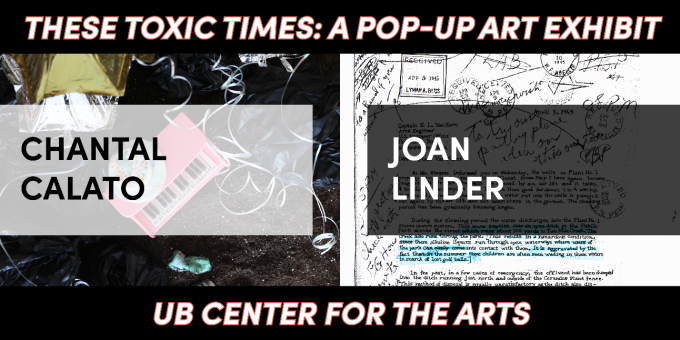
These Toxic Times: A Pop-Up Art Exhibit
Center for the Arts (Screening Room Hallway) | On view March 7-13
Reception: Wed., March 11, 3:30 p.m. - 4:30 p.m.
On view, reproductions of selected works from Life: a work on progress
Lead Poisoning, Life: a work on progress [original: Giclee photographs on cotton, 40” x 60”, 2024]
Toxic, Life: a work on progress [original: Giclee on cotton, 26.6” x 40”, 2020]
I grew up next to the infamously toxic Love Canal. The woods and creek I played in at my dads house as a child were only a mile from the world’s largest dump of uranium, a remnant of the Manhattan Project that has yet to be cleaned up. With more than 800 known waste sites, Western New York’s industrial history has left a lasting scar on the land, its community, and me. Environmental destruction has been the driving force in my work for the past two decades.
The two photographs presented here are part of an ongoing series called LIFE: a work on progress. At a first glance viewers may think they are looking at real objects within the photos. Upon closer inspection, one will notice undue texture, hand scribbled labels, and scale that is slightly askew - the objects within the photographs are actually hand built miniatures printed to appear roughly life-size.
“Toxic” is a reflection of the painful consequences of growing up surrounded by toxic waste. My most recent photo “Lead Poisoning” highlights the objects from my daughter’s first birthday after she tested positive for lead poisoning. We tested our house and found it was full of lead dust from the old windows, and the soil outside had brownfield levels of lead from decades of rainwater runoff.
In 2025 Calato was awarded the Anonymous Was A Woman Environmental Arts Grant and a Generator Fund Grant through BICA. She has received multiple Creative Impact Fund Grants to develop new sculptures. Calato was named Artist of the Year Finalist in 2021 by Arts Services Inc for her solo environmental show UNSEEN at the Burchfield Penney Art Center. In 2018 she received the Global Warming Art Project grant. Her environmental works have been shown at the Castellani Art Museum, Artist Archives of the Western Reserve, Art Park and the Buffalo Museum of Science. Calato’s environmental work has been the subject of talks on NPR, in humanities festivals and was recently written about in The Age of Loneliness, by author Laura Marris, published by Graywolf Press in 2024.
On view, reproductions of selected works from the Toxic Archives series, part of the Operation Sunshine, 2013 - 2017.
"Joan Linder: Operation Sunshine presents meticulously hand-drawn replicas of archival documents...[t]aken together, these deftly rendered images faithfully record the passing of time, subtly calling into question the authenticity of information. With each incidental mark and imperfection, Linder’s hand is evident. Her ardent observations create a poignant, collective memory that bears witness to the improbability and travesty of historical events."
(Excerpt from the Joan Linder: Operation Sunshine catalogue, Holly Hughes Bohner, Godin-Spaulding Curator & Curator for the Collection, Buffalo AKG Museum, 2016.)
Linder was born and bred in suburban New York. She lives with humans and non-humans in Buffalo. A Professor of Art at University at Buffalo SUNY, she is represented by Cristin Tierney Gallery in NYC.