


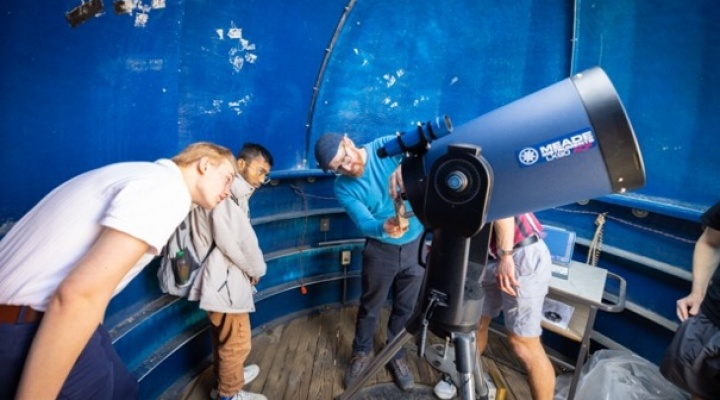
Inside UB’s observatory dome, PHY 386 students learn how to align and operate the department’s telescope while exploring AI-powered methods for analyzing astronomical data.
In this Issue:
Support your Department
With gifts from alumni and friends, we can access crucial resources to enhance our department and support students, research projects and new programs.

Xuedong Hu, Professor and Chair
The first snow has come and gone in Buffalo, and the Fall semester is rumbling by before we know it. Hope this past year has been rewarding for you in terms of your health, family life, and professional career!
Year 2025 has seen one challenge after another for Higher Education in general, with the keywords being change and uncertainty. While the multitude of federal policy shifts and reversals have mostly settled down by now, further uncertainties are still ahead of us, whether the proposed drastic cut in indirect cost for federal grants, or the alarming trend of declining international student enrollment for many universities. And the list goes on and on. The head wind is also not limited to the federal level. Within the State of New York, the declining population has severely impacted many smaller SUNY campuses in recent years. While UB has weathered the storm reasonably well so far, the trend certainly poses a serious question for UB in general, and UB Physics in particular: What changes and additions could we make to deliver the best education package to our students?
Our faculty members have also continued to receive external recognition and awards for their excellence in research. Professor Dejan Stojkovic became the latest UB Physics faculty member who received the SUNY Chancellor’s Award for Excellence in Scholarship and Creative Activities. Professor Hao Zeng has received a Fulbright Scholarship for his planned collaboration with scientists in Japan. Professor Ia Iashvili received the UB Exceptional Scholar Award for Sustained Excellence in Research for her works in the CMS Collaboration at LHC. And all five UB experimental High Energy Physics professors, Ia Iashvili, Avto Kharchilava, Christine McClean, Sal Rappoccio and David Yu have received the 2025 Breakthrough Prize in Fundamental Physics as members of the CMS Collaboration at LHC.
Despite all the challenges, there has been plenty of positive news around the Department. Indeed, our faculty has stayed on the growing trajectory that started from a few years ago: We welcomed two new faculty members in January of 2025, when two Assistant Professors, Christine McLean and David Yu, who specialize in experimental particle physics, joined. Then in August 2025, Jamir Marino, a theorist working at the confluence of condensed matter physics and quantum optics, joined us as an Assistant Professor. At present we are searching for an experimental physicist specializing in quantum sensing. The influx of these new faculty members broadens our research portfolio, and helps ensure the long-term stability of the Department.
Our undergraduate students have always done well in balancing their academic endeavor with a variety of interesting extracurricular activities, such as the weather balloon observation of the total solar eclipse from last spring. This year, our SPS Chapter, the main student organization for physics majors, again received the Distinguished SPS Chapter award. Indeed the Chapter has won five annual awards in the past ten years, and we are very proud of its accomplishments and grateful for its service to the Department and our students! Several of our majors have been inducted into the Sigma Pi Sigma Physics Honor Society due to their excellent academic performance, including Genevieve Bauso, Jeffrey Cai, Jack Garcia Young, Quentin Gibbons, Karl Guenther, and Riley Totten. The induction ceremony will take place in December 2025.
After having two large incoming graduate classes in 2023 and 2024, the new class of 12 graduate students joining UB Physics in the fall of 2025 is relatively small. Nevertheless, they will surely make their contribution to the exciting research in the Department for years to come.
This year we had two very interesting and well attended public lectures. On April 18, 2025, our T.Y. Wu Lecture was given by Christopher Murray of University of Pennsylvania, a world-renowned chemist who is a pioneer in chemically synthesized quantum dots. His PhD research at MIT partly contributed to his advisor M. Bawendi receiving Nobel prize in 2023. The title of his lecture is “Building with Artificial Atoms: The Design of Multifunctional Nanomaterials and Devices through Nanocrystal Self-Assembly.” On November 14, our Moti Lal Rustgi Lecture was given by Professor Christopher Monroe from Duke University, a pioneer of trapped-ion quantum computing who in his spare time contributed significantly to the establishment of the National Quantum Initiative, as well as co-founded IonQ, Inc. The title of his talk is “Quantum Computing: What, How, and When?” With the quantum dot Nobel prize given only two years ago, and general fascination over quantum computing growing, with the 2025 Nobel Physics Prize just given to three original contributors to the demonstration of macroscopic quantum tunneling and coherence in Josephson junctions, these lectures are both fascinating and timely. Both attracted great crowds, with enthusiastic participation from students in the audience.
For those of you who are interested in news at UB beyond Physics, there are quite a few, too. UB’s top leadership will change soon: President Satish Tripathi is stepping down in the summer of 2026, and the search for a new president has already started. We have had a very steady leadership over the past two decades: Satish has been UB’s President since 2011, and was the Provost from 2004 to 2011. In the College of Arts and Sciences, we welcomed a new Dean, Jeff Grabill, in August 2025. He has since visited all the departments in CAS, including Physics, and came across as personable and willing to listen. Last but not least, UB has launched a new Quantum Institute in order to coordinate and fully harness the research expertise of UB faculty in quantum information science (QIS). Our former chair and current Associate Dean of Research at CAS, Professor Sambandamurthy Ganapathy, has been named the interim Director of the Institute. Faculty of UB Physics should be in a unique position to benefit from this new Institute due to our strong expertise in QIS.
Let me end my message with some more positive sentiment. Physics has been fundamental to all the modern technologies, and thus to the modern world. I do not see this relationship change at all. As such, we will continue to take our responsibilities to the Society, the University, and the future of the Department seriously, and move forward with optimism and an open mind.
Please share with us stories of your work and your life. And have a great 2026!
Best wishes,
Xuedong Hu
Chair and Professor of Physics

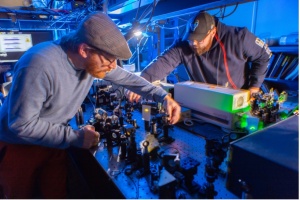
Prof. Tim Thomay and graduate student Jeffrey Carvalho fine-tune the setup used in their new open-access Journal of Optics publication on quantum light sources.
New Insights into Quantum Light
By Tim Thomay, PhD
The Thomay group recently published new research in the Journal of Optics on “spectrally-resolved higher-order photon statistics of spontaneous parametric down-conversion (SPDC)”. This nonlinear optical process, in which a single photon splits into a pair of entangled photons, is a cornerstone of modern quantum optics. Using a four-detector Hanbury Brown and Twiss interferometer coupled to a spectrometer, the team systematically explored how photon correlations vary with wavelength, pump power, and coincidence time. The results revealed a striking wavelength dependence: shorter wavelengths produced nonlinear increases in photon numbers with pump power, while longer wavelengths followed a more linear trend.
These findings shed light on fundamental questions about photon generation efficiency and provide new experimental strategies for characterizing complex states of light. By demonstrating a method to probe higher-order photon statistics without the need for number-resolving detectors, the work lays important groundwork for designing the next generation of quantum light sources. Such advances hold promise for applications in secure quantum communication, ultra-precise quantum metrology, and imaging technologies that exploit non-classical states of light. This research not only deepens our understanding of the physics of SPDC, but also strengthens UB’s profile in the rapidly expanding field of quantum photonics.
The New Insights into Quantum Light article is open access as part of a partnership between New York State and IOP Publishing, making it freely available to the public.

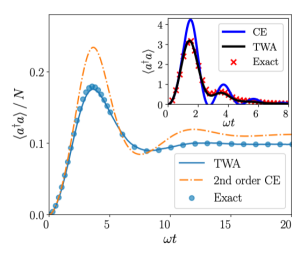
The evolution of a single spin under coherent driving and spontaneous decay. TWA (solid lines) shows strong agreement with the exact solution (circles) for weak to moderate loss rates. Credit: PRX Quantum (2025). The Cumulant Expansion (CE) curves are also shown. DOI: 10.1103/1wwv-k7hg
Quantum dynamics on your laptop? New UB method brings that vision closer
By Jamir Marino, PhD
A fresh computational technique from UB physicists promises to make simulating complex quantum systems far more accessible. In a new paper in PRX Quantum, User-Friendly Truncated Wigner Approximation for Dissipative Spin Dynamics, researchers led by Assistant Professor Jamir Marino present a user-friendly extension of the truncated Wigner approximation (TWA) that works for open, dissipative quantum spin systems—i.e. systems that exchange energy with their environment and are constantly subject to drive. Traditionally, TWA has been restricted to ideal, isolated quantum systems. Marino’s team breaks through that limitation by developing a conversion table that lets physicists directly map a wide range of quantum spin problems into stochastic classical equations that can be run on consumer hardware. Key advantages of the new method: Low computational cost, making it possible to simulate complex dynamics in hours rather than days on supercomputers; Simplicity and generality: the approach removes much of the problem-specific derivation burden;
Competitive or superior performance compared with cumulant expansion methods in test models, especially in regimes relevant to atomic, molecular, and optical systems (e.g. lasing, Rydberg arrays, central-spin models). “Physicists can use supercomputing resources on the systems that need a full quantum approach and solve the rest quickly with our approach,” Marino says.
Because the method runs on standard laptops, it could accelerate exploratory studies in open quantum many-body dynamics—reserving supercomputers for only the most demanding cases. Marino carried out much of the research while affiliated with Johannes Gutenberg University Mainz; co-authors include Hossein Hosseinabadi and Oksana Chelpanova, the latter now postdoc at UB. Funding was provided by the National Science Foundation, the German Research Foundation, and the European Union.
Read the full paper Quantum dynamics on your laptop? New UB method brings that vision closer

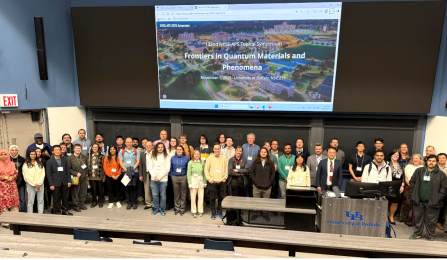
Participants of NYSS APS Fall 2025 Symposium at UB

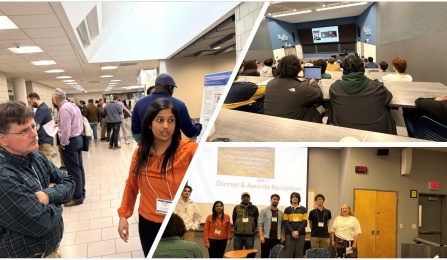
Students participating in NYSS APS Fall 2025 Symposium
NYSS APS Fall 2025 Symposium at UB
By Changjiang Liu, PhD
The University at Buffalo hosted the 132nd Topical Symposium of the New York State Section of the American Physical Society (NYSS-APS) on November 1, 2025, under the theme Frontiers in Quantum Materials and Phenomena. The full-day event brought together over 100 participants from across New York State and the broader Northeast to exchange ideas on emerging directions in condensed-matter physics, materials science, and quantum technologies.
The symposium opened with welcome remarks by Venu Govindaraju, Vice President for Research & Economic Development; Jeff Grabill, Dean of the College of Arts and Sciences; and Xuedong Hu, Chair of the Department of Physics. The scientific program featured four thematic sessions—Photonics & 2D Materials, Quantum Crystals & Circuits, Education & Posters, and Topology, Spin & Probes—with invited presentations spanning a broad scientific landscape. Highlights included Paras N. Prasad (UB) outlining an AI-accelerated roadmap for quantum metrology and biotechnology; Zhong Lin (Binghamton) revealing spin–lattice coupling in layered antiferromagnets; Valla Fatemi (Cornell) describing Andreev spin qubits; Jeremy Levy (Pittsburgh) discussing programmable quantum matter in oxide and van der Waals heterostructures; James Hone (Columbia) presenting compact superconducting qubits and his group’s detailed investigation of defects in two-dimensional materials; Chandralekha Singh (Pittsburgh) showcasing research-based tools for teaching quantum mechanics; Cui-Zu Chang (Penn State) reporting interface-induced superconductivity in QAH heterostructures; Igor Žutić (UB) exploring Josephson junctions and spintronics; and Mengkun Liu (Stony Brook) introducing nanoscopy techniques for imaging quantum phenomena.
A lively poster session featuring over 40 presentations from undergraduate, graduate, and postdoctoral researchers reflected the wide range of research across the region—from quantum materials synthesis and characterization to quantum information, photonics, and computational physics. Topics included quantum transport and topological phases, machine-learning-assisted materials design, nonlinear electronic phenomena, superconducting devices, and nanoscale imaging. The posters showcased the depth and diversity of student-led research from UB and partner institutions across New York State. Three undergraduate and seven graduate students received poster awards during the evening dinner and awards reception.
The symposium was co-organized by UB faculty Changjiang Liu, Vasili Perebeinos, and Wanyi Nie, with support from APS, the UB Department of Physics, and the Department of Electrical Engineering. The organizers also wish to thank Professor Sambandamurthy Ganapathy, Associate Dean of the College of Arts and Sciences, for chairing the Photonics & 2D Materials session and for his continued support of departmental activities. The organizers gratefully acknowledge the assistance of student volunteers Nawanath Budhathoki, Sangit Baskota, Kevin Euscher, Samuel Fagle, and Nathan Haskins, whose help with registration, setup, and logistics contributed greatly to the success of the symposium.
Visit the symposium website to view the full program and photos from the event.

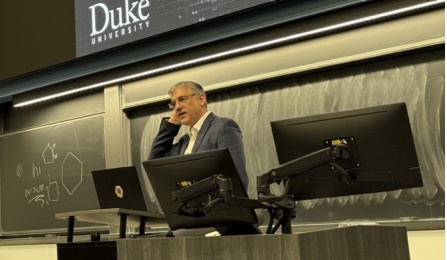
Prof. Christopher Monroe (Duke Universiry) gives Rustgi Lecture 2025 at UB

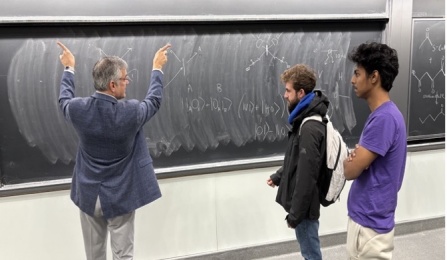
Prof. Christopher Monroe answers questions from students
Moti Lal Rustgi Lecture for 2025
By Xuedong Hu, PhD
On November 14, 2025, UB Physics hosted the 29th Moti Lal Rustgi Memorial Lecture. The Moti Lal Rustgi Memorial Lecture Series was established in 1993 through a generous endowment from the Rustgi family to honor and remember former Physics colleague Professor Moti Lal Rustgi. The lecture is given annually by distinguished researchers on topics that have broad appeal. The 29th lecture in this series, titled “Quantum Computers: What, How, and When?” was given by Christopher Monroe.
Professor Monroe is the Gilhuly Family Presidential Distinguished Professor of Physics and Electrical Engineering at the Duke University. He is a pioneer in trapped ion quantum computing, an important contributor to the establishment of the National Quantum Initiative in the US, and a co-founder of IonQ, Inc.
The topic of Professor Monroe’s lecture is a perfect fit to the UN endorsed Year of Quantum celebration of the advent of quantum mechanics. It also came soon after the 2025 Nobel Physics Prize was given to three physicists who demonstrated macroscopic quantum tunneling and coherence in Josephson junctions in the mid 1980s, laying the foundation for superconductor-based quantum computing. The Lecture was well attended, and the audience, especially the students, was very engaged. Indeed, after 15 minutes of Q&A at the end of the lecture, they asked numerous questions for another 15 minutes until we had to leave the classroom. As for all public lectures in the past, UB Physics students also had the opportunity to join Professor Monroe for lunch, where they asked questions about research directions and career paths, continuing our tradition of encouraging student interactions with leading experts.

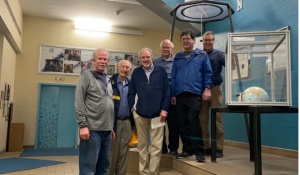
Dr. John Cerne gives tour of Fronczak Hall to the Western New York Mensa Chapter members.
Western New York Mensa Chapter members visit UB Physics Department
By John Cerne, PhD
On October 14, Dr. John Cerne gave a tour of Fronczak to the Western New York Mensa Chapter. This included touring the Camera Obscura and Foucault pendulum. The Chapter members asked many great questions and had a lot of stimulating conversations about physics and technology with Dr. Cerne.
Meet our New Faculty Members

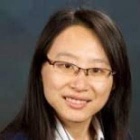
Professor Wanyi Nie
Professor Wanyi Nie joined the Department of Physics at the University at Buffalo in Spring 2024. Her research spans the cutting edge of novel semiconductors, optoelectronic devices, and clean energy technologies. Her group focuses on developing organo-metal halide perovskites and metal-organic frameworks, with applications ranging from X-ray imaging and infrared detection to spintronics and photovoltaics.
Prior to joining UB, Prof. Nie was a staff scientist at Los Alamos National Laboratory. She earned her PhD from Wake Forest University and completed postdoctoral training at Texas A&M University. Since joining UB, Prof. Nie has built the SHIELD Lab (Semiconductor and Hetero-Interface Electronic Device Group) from scratch. There, students and collaborators explore light-induced structural dynamics, chiral perovskite interfaces, and radiation-stable materials. Their work has already appeared in many leading scientific journals. In under two years, Prof. Nie has already secured major federal funding, including a Department of Energy grant to enhance the stability of perovskite solar modules, a Department of Defense award for space-based solar technologies, and most recently, a National Science Foundation grant to investigate chiral materials.

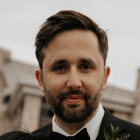
Assistant Professir Dusan Sarenac
Dusan Sarenac joined UB Physics in Spring 2024 as an Assistant Professor. He is an experimental physicist whose research spans quantum optics, neutron scattering, and biomedical photonics. Dusan completed his PhD at the University of Waterloo and was a Research Associate at the Institute for Quantum Computing before joining UB.
His work is characterized by the development of novel beam shaping techniques—particularly structured neutron and photon wavefronts—for quantum measurement, materials characterization, and biomedical applications.
In neutron science, his group develops next-generation neutron optics tools that extend beyond traditional spin and path degrees of freedom. In collaboration with national labs including Oak Ridge and NIST, they introduced orbital angular momentum (OAM) states into neutron beams and are now integrating OAM with scattering tomography to probe 3D spin textures and topological order in quantum materials. In parallel, Dusan leads an interdisciplinary effort in vision science, applying structured light and entoptic stimuli to detect eye disease before vision loss occurs. This work, done in collaboration with the University of Waterloo School of Optometry and the Centre for Eye and Vision Research in Hong Kong, merges techniques from quantum optics and vision science to create diagnostic tools for early detection of age-related macular degeneration and pathological myopia.

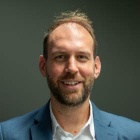
Assistant Professir Jamir Marino
In August 2025, Dr. Jamir Marino relocated his research group, NEUQUAM, working on interdisciplinary non-equilibrium quantum many-body physics, from the Johannes Gutenberg University of Mainz to the UB.
Here he is launching several new research threads, including non-equilibrium field theory for condensed matter, non-equilibrium phase transitions (such as pre-thermalization, glasses and kinetically constrained systems), dissipative engineering of many-body entangled states, hybrid quantum circuits and strongly correlated light–matter interfaces. His team’s research explores whether quantum phenomena can persist at long times and over large scales in many-body systems, both isolated and under driven–dissipative conditions. A central goal is to identify emergent phases of matter that require a genuinely quantum description, beyond any classical surrogate effective modeling.
Dr. Marino earned his PhD at SISSA in Trieste, Italy. During his postdoctoral work, he held Alexander von Humboldt and Marie Curie Fellowships, dividing his time between Germany and Harvard University. He has also been a visiting researcher at ETH Zurich and UC Berkeley. In October 2019 he was appointment Assistant Professor at the University of Mainz, working there until his recent move to the UB. In addition to his work at the UB, Dr. Marino is establishing a satellite group at ICTP-SAIFR in São Paulo, Brazil, which will be inaugurated November 2025. This initiative will strengthen UB’s connections with the Brazilian scientific community.
Dr. Marino has published influential reviews on dynamical phase transitions, driven open quantum systems and the foundations of Lindblad theory.

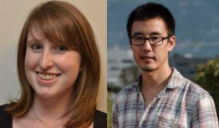
Assistant Professors Christine McLean and David Yu
The High Energy Physics Experimental Group has recently grown to include Assistant Professors Christine McLean and David Yu. They both join the Compact Muon Solenoid (CMS) experiment at the Large Hadron Collider (LHC) in Geneva, Switzerland. They join Profs. Ia Iashvili, Avto Kharchilava, and Salvatore Rappoccio
Prof. Christine McLean's work focuses on measurements of proton-proton collisions where carriers of the weak nuclear force (the W and Z bosons) are emitted by the incoming protons to collide with each other and produce yet more bosons. This is sensitive to the details of the "Higgs mechanism," whereas the Higgs boson gives mass to all of the massive fundamental particles. She is also a leading expert in using solid state devices (such as silicon chips) to track the trail left by charged particles such as protons and pions that are produced in the proton-proton collisions at the LHC.
Prof. David Yu's work focuses on measurements of Higgs bosons that decay to hadronic particle jets via bottom quark-antiquark pairs, charm quark-antiquark pairs, or pairs of gluons, as well as searches for new interactions in nature that also produce Higgs bosons. He was the deputy Project Manager for the Hadronic Calorimeter (HCAL) project. His work focuses on using machine learning and artificial intelligence techniques to identify Higgs bosons decaying to hadronic particle jets.

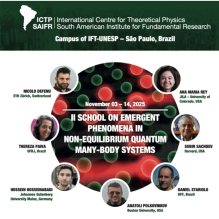
ICTP-SAIFR School in São Paulo, Brazil
By Jamir Marino, PhD
November 3–14, 2025, Prof. Marino will kick off his collaborations at ICTP-SAIFR (International Center for Theoretical Physics – South American Institute for Fundamental research) with a two-week school on the dynamics of quantum many-body systems.
Designed for Master’s and PhD students, the program covers foundational concepts and cutting-edge tools, including statistical mechanics, field-theoretical methods, semiclassical techniques, and the physics of disordered and driven-dissipative systems. Applications are interdisciplinary, from material science to AMO systems
A highlight will be two guest lectures by Subir Sachdev (Harvard University) on quantum criticality and emergent phenomena in non-Fermi liquids and strange metals. Alongside lectures, the school features interactive discussions and problem sessions, fostering collaboration and hands-on learning. This event marks the start of a series of annual schools and workshops from 2026 onwards, open to UB students and postdocs at any level of their career path, aimed at building expertise in the fast-growing field of non-equilibrium many-body physics.

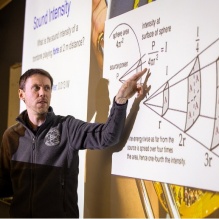
The Physics of Music seminar course at UB
By Benedikt Harrer, PhD
In the UB Seminar course “PHY 199 – The Physics of Music”, taught by Associate Teaching Professor Benedikt Harrer, first-year students explore UB's North Campus soundscape through an assignment that blends acoustic science with an exploration of their new campus environment. Students use smartphone apps to measure the sound intensity levels of various sound sources on campus and document the loudest, quietest and most surprising sounds they encounter–from vending machines and elevator dings to “silent” study spaces and UB's marching band.
The activity encourages students to engage with their surroundings in a new way, using acoustics to uncover patterns and unique features of their everyday sonic environment. It’s a creative introduction to physics that also helps students connect with their new campus through observation, curiosity and reflection.

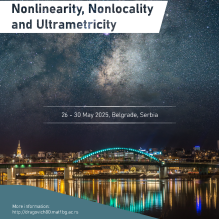
Nonlinearity, Nonlocality and Ultrametricity Conference
By Dejan Stojkovic, PhD
As a full member of the Serbian Academy of Nonlinear Sciences (SANS), Prof. Stojkovic co-organized the international conference "Nonlinearity, Nonlocality and Ultrametricity" (Belgrade, May 2025), honoring the 80th birthday of Prof. Branko Dragovich, President of the SANS. The event gathered over 100 participants from Europe, North America, and Asia

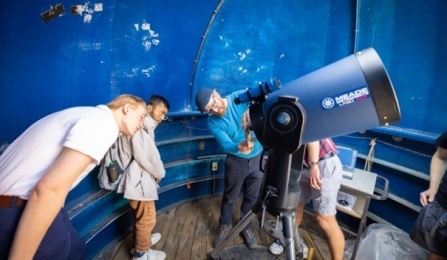
Inside UB’s observatory dome, PHY 386 students learn how to align and operate the department’s telescope while exploring AI-powered methods for analyzing astronomical data.

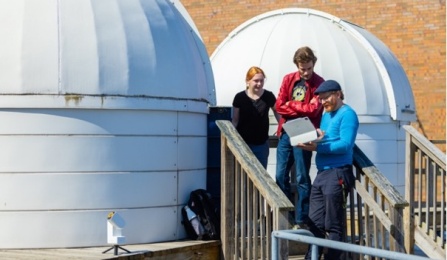
PHY 386 students outside UB's observatory dome.
Hands-On Astronomy with AI at UB
By Tim Thomay, PhD
Spring 2025, Prof. Thomay launched Computational Methods for Physicists (PHY 386), a new undergraduate course that blends coding, data analysis, and AI with real-world applications in astronomy. Students learn modern computational tools such as Jupyter, pandas, and Astropy, applying them directly to data from UB’s own telescope observation facility. The course culminates in a hands-on astronomy event where students use AI techniques to analyze and interpret telescope data, exploring applications that ranges from signal processing to pattern recognition in astronomical images. This unique integration of classroom learning, AI methods, and direct observation give students a rare opportunity to see how computational physics connects to discovery in astronomy. By fostering both technical skills and scientific curiosity, the course demonstrates how UB students can engage with frontier technologies in a way that is grounded in authentic astronomical research.
Faculty Recognitions

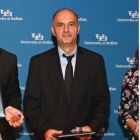
Professor Dejan Stojkovic
Stojkovic has received the SUNY Chancellor’s Award for Excellence in Scholarship and Creative Activities for his continued efforts in seeking solutions to some of the most fundamental problems at the interface of particle physics, gravity and cosmology.
One of his most important recent contributions to cosmology is his proposal of using quasars (extremely bright distant objects powered by black holes) as measures of distance in the study of the expanding universe. His work of the highest impact to the particle physics community is the event generator BlackMax, which is extensively used by all the collaborations at the Large Hadron Collider in CERN in search for new physics. He works on classical and quantum aspects of black holes at all scales (from microscopic primordial black holes to supermassive black holes located in centers of galaxies).
He also works on cosmological puzzles like dark matter (missing mass in our universe) and dark energy (mysterious ingredient that drives accelerated expansion of our universe). Having a truly adventurous mind, Dejan has most recently turned his sight on foundations of quantum mechanics as well. Over his career, Dejan has published more than 100 papers, with an H-Index of 43 (Google Scholar); written one book, a chapter in another and edited two books; and given numerous seminars, colloquia, and public presentations. He is also one of the most visible among UB physicists in terms of mass media coverage, with his research reported by New York Times, CNN, USA Today, NBC News and others.

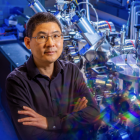
Professor Hao Zeng
Hao Zeng, a Moti Lal Rustgi Professor in Physics, has received a Fulbright Scholarship for a planned collaboration with Prof. Hideo Hosono at the Institute of Science, Tokyo. Professor Zeng is an international leader in materials science and physics, with pioneering work in magnetic nanoparticles, data storage and permanent magnets.
Over the past decade, his group achieved a breakthrough in the field of two-dimensional (2D) materials by experimentally demonstrating the magnetic proximity effect on monolayer transition-metal dichalcogenides (TMDs) for the first time. They uncovered a novel mechanism behind topological-Hall-like signals in 2D magnets and developed new strategies to control them, with potential applications in neuromorphic computing. They have pioneered the integration of 2D magnets with 2D TMDs through a patented technique called dative epitaxy.
Hao’s research also extends to chalcogenide perovskites, an emerging class of semiconductors with exceptionally strong light–matter interactions. For example, his group has demonstrated controlled phase engineering to realize different types of chalcogenide perovskite films, with potential applications in photovoltaics and optoelectronics. As part of his Fulbright Scholarship, he will collaborate with Prof. Hideo Hosono, whose group discovered strong green light emission in these materials. They aim to advance the material toward optoelectronic applications by taking advantage of expertise from both groups.

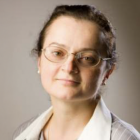
Professor Ia Iashvili
Ia Iashvili has been recognized with the Exceptional Scholar Award for Sustained Achievement for her tireless and impactful work on the Compact Muon Solenoid (CMS) at the Large Hadron Collider in Geneva, Switzerland. She is a world-leading expert in the reconstruction and calibration of hadronic particle jets produced by the strong nuclear force.
The work of her and her research team is used extensively throughout the CMS experiment, impacting thousands of publications and contributed to the discovery of the Higgs boson in 2012. Her research also investigates models of new interactions that decay to pairs of the heaviest known fundamental particle, the top quark, which can include dark matter that interacts with top quarks, large extra spatial dimensions producing heavier force carriers, and heavier copies of the electroweak interaction.

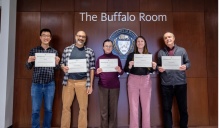
UB Physics professors (from left to right) David Yu, Salvatore Rappoccio, Ia Iashvili, Christine McLean and Avto Kharchilava received 2025 Breakthrough Prize in Fundamental Physics.
Breakthrough Prize in Fundamental Physics
On Saturday 5th April Patty McBride, former CMS Spokesperson, received the 2025 Breakthrough Prize in Fundamental Physics on behalf of the CMS Collaboration. The University at Buffalo CMS group includes Ia Iashvili, Avto Kharchilava, Salvatore Rappoccio, with new faculty members Christine McLean and David Yu who joined in spring 2025.
This was a joint award, along with ATLAS, LHCb and ALICE Collaborations. It was presented to the Spokespersons by Yuri Milner and Jeff Bezos, at an award ceremony in Los Angeles for “Detailed measurements of Higgs boson properties confirming the symmetry-breaking mechanism of mass generation, the discovery of new strongly interacting particles, the study of rare processes and matter/antimatter asymmetry, and the exploration of nature at the shortest distances and most extreme conditions at CERN’s Large Hadron Collider”.
The $3M prize (CMS share is $1M) will be donated to the CERN and Society Foundation to offer grants to doctoral students from member institutes to spend research time at CERN.
In 2013 the spokespersons of ATLAS and CMS Collaborations, together with then director of the LHC project Lyn Evans, received a special Breakthrough Prize in recognition of the discovery of the Higgs boson. This new award recognizes that the discovery was just the beginning of an extensive and detailed research program in CMS on the properties of the Higgs boson, as well as a comprehensive range of studies of the electroweak scale and beyond, matter/antimatter asymmetry, and probing the hot, dense state of nuclear matter that prevailed in the early Universe. This has all been accompanied by direct and indirect searches for new phenomena and particles to try to answer some of the most fundamental questions: what is the nature of Dark Matter? Why is there such an extreme imbalance between matter and antimatter in the Universe? Why are some particles more massive than others?
The University at Buffalo group has played an integral role in the physics program of the CMS experiment at the LHC, including searches for physics beyond the standard model as well as measurements of various electroweak and strong processes. Their contributions include construction, commissioning, and operation of the CMS detector, as well as extensive work in reconstruction and identification of hadronic jets.
Faculty Awards

Associate Professor Wanyi Nie and SUNY Distinguished Professor Igor Žutić
Wanyi Nie and Igor Žutić have received a new National Science Foundation grant award number DMR-1848371, to investigate exciton dynamics in chiral heterostructures, a frontier topic in quantum materials science.
A chirality or handedness of a material implies that its mirror image cannot be superimposed on itself through only rotations and translations. This is exemplified with DNA and inherent to many organic molecules, where the left/right handedness has direct similarities with the two-state spin systems and spintronics. However, after decades of studies, the chirality transfer from chiral materials to their achiral neighbors remains poorly understood. To address these challenges, the proposed research will experimentally probe the dynamical properties of excitons, bound electron-hole pairs, which are fundamental to light-matter interaction. Together with a closely integrated theoretical studies, it will be possible to elucidate the chiral proximity effect and the transformation of initially achiral materials through the changes in excitons.

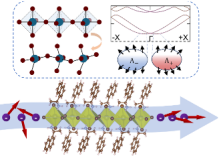
Octahedral crystal field of achiral inorganic semiconductors becomes deformed from the neighboring organic chiral molecules. The resulting chiral proximity effect transforms electronic structure and transport properties.
These findings could lead to breakthroughs in optoelectronic devices, quantum information processing, and energy-efficient technologies by leveraging the unique properties of chiral systems to control exciton transport and recombination. How this collaborative work could work in practice can be seen in the Figure, from the joint publication of Nie’s and Žutić’s group, where they have also teamed up with Dr. Mark van Schilfgaarde, the Chief Theorist at the National Renewable Energy Laboratory, Golden, CO. Hybrid structures of chiral organic molecules and achiral inorganic semiconductors, experimentally studied in Nie’s group, have been theoretically explored by combining first-principles methods, symmetry analysis, and many-body calculations in the group of Žutić.
Nie is an Associate Professor whose research focuses on radiation-matter interactions, hybrid semiconductors, and advanced photonic materials. Her interdisciplinary approach combines spectroscopy, materials synthesis, and device integration to address fundamental questions in condensed matter physics. Žutić is a SUNY Distinguished Professor, who works on various topics in theoretical condensed matter physics, from spin-dependent phenomena to topological quantum computing.

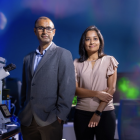
Postdoctoral researcher Sukanya Srinivasan (right) and Prof. Banerjee's (left).
Professor Priya R. Banerjee
Priya R. Banerjee has received a new $2.1 million award from the National Institutes of Health (NIH) to advance understanding of how proteins and RNA organize within cells to regulate essential functions—and how disruptions in this process may contribute to disease. The four-year grant, part of NIH’s Maximizing Investigator’s Research Award (MIRA) program, will allow Banerjee’s team to investigate the biophysical principles underlying RNA-driven condensates—microscopic, membrane-less droplets that help compartmentalize biochemical reactions in cells. These droplets form through a process known as liquid–liquid phase separation, which enables certain biomolecules to cluster together dynamically without the need for a surrounding membrane.
Banerjee, a professor of physics, has previously demonstrated that protein condensates behave as viscoelastic materials, exhibiting both liquid and solid-like properties. His group has shown that changes in sequence or cellular environment can alter condensate behavior over time, leading to transitions that resemble those seen in neurodegenerative diseases such as ALS and Huntington’s disease. The new project will focus on how RNA contributes to condensate formation, maturation, and regulation within living cells. Using a combination of biophysical measurements, microscopy, and cell-based experiments, the Banerjee Lab aims to link molecular sequence features of RNA and proteins to the emergent material properties of condensates.
“Our goal is to understand how these droplets form, age, and sometimes transition into aberrant states that can impact cell health,” Banerjee said. “By studying how normal condensates are maintained, we can better identify what goes wrong in disease.” The MIRA program supports innovative and integrative approaches by providing investigators with long-term, flexible funding.
In addition to Banerjee’s award, postdoctoral fellow Sukanya Srinivasan, a recent NIH F32 fellowship recipient, will continue leading complementary work on RNA-driven condensate regulation. Ultimately, the findings are expected to provide new insights into how cells organize and protect their molecular contents, as well as inform strategies for targeting or engineering biomolecular condensates in biomedical and biotechnological applications.

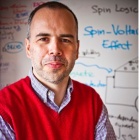
SUNY Distinguished Professor Igor Žutić
Igor Žutić, a SUNY Distinguished Professor, has received a new grant from the National Science Foundation, ECCS-2512491, “Spin-Controlled Light-Emitting Diodes and Lasers” and, as a Co-Principal Investigator, a group grant from the European Innovation Council, “Spin-V(E)CSELS for Ultrafast and Highly-Efficient Space Data Communications.” Both grants have evolved from his collaboration with experimentalists from Europe, who have visited UB, and their joint publications, including Controlling the Helicity of Light by Electrical Magnetization Switching, Nature 627, 783 (2024) and M. Lindemann et al., Ultrafast Spin-Lasers, Nature 568, 212 (2019).

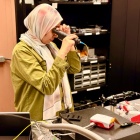
NSF-supported graduate student Yasmin Sarhan works in the optics lab.
Professor Tim Thomay’s group awarded a new National Science Foundation grant
Prof. Tim Thomay’s group has been awarded a new National Science Foundation grant “EAGER: Exploratory Study of Hybrid Quantum Encoding in Ring Multicore Fibers at Visible Wavelengths” to expand its research on non-classical states of light and their applications. The project focuses on higher-order photon states, which are of growing interest in the quantum science community because of their potential to unlock capabilities not accessible with traditional single-photon sources. The group aims to develop new experimental techniques that can generate and precisely characterize these advanced quantum light sources, paying particular attention to how their photon statistics can be controlled and tailored.
The main goal of the project is to push these sources beyond proof-of-principle demonstrations and toward practical applications. Advanced quantum light could dramatically improve secure communication by increasing channel capacity and resilience against eavesdropping, while in sensing and metrology it has the potential to achieve levels of precision beyond the shot-noise limit. Higher-order photon states may also play a critical role in building scalable architectures for quantum computing, where fine control of photon statistics is essential for error correction and reliable information processing. By investigating the underlying physics while keeping applications in view, the Thomay group seeks to chart pathways from the laboratory to real-world technologies.
The award also provides significant opportunities for student involvement. Graduate and undergraduate researchers will contribute to experimental design, work with state-of-the-art optical setups, and engage in theoretical modeling and data analysis. Their training will prepare them to participate in the rapidly growing quantum technology sector, while also strengthening UB’s position as a center for advanced photonics research. In this way, the grant supports not only scientific discovery but also the cultivation of the next generation of physicists who will drive innovations in quantum communication, sensing, and computing.

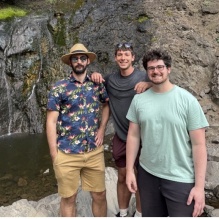
Physics PhD students Trey Wojnar (center) and John Verdi (right) in the San Juan Mountain range in Colorado, at one of many trips taken during their summer internship working at Los Alamos National Lab (LANL).
Summer Internships
By Hao Zeng, PhD
Three graduate students from Dr. Hao Zeng’s group completed summer internships at either a national lab or in industry. Physics PhD students John Verdi and Trey Wojnar received their bachelor’s degrees in mathematical physics at UB under the mentorship of Dr. Zeng and have continued their research with him into graduate studies. Their work combines research on 2D magnetic materials with the expertise of the Laboratory for Ultrafast Materials and Optical Science (LUMOS) team in the Center for Integrated Nanotechnologies (CINT) at LANL, bridging the fields of magnetism and ultrafast spectroscopy. During their time at LANL, they gained experience with ultrafast systems and explored how the properties of 2D magnets can enhance magnetic memory as well as the performance of terahertz (THz) emitters, detectors, and modulators. They also conducted multiphysics simulations, successfully detecting Weyl points in the gigahertz (GHz) range within a layered 3D double gyroid metamaterial that breaks parity symmetry. Looking ahead, they plan to spend the next year honing their skills with device fabrication and material synthesis to prepare them for a return to LANL, where they aim to transform their simulations into experimental results--identifying parity-breaking 3D metamaterials that exhibit Weyl points in the THz range and further investigating the connection between 2D magnets, THz spectroscopy, metamaterials.
MCgen Fellowship
By Dejan Stojkovic, PhD
Mr. Amartya Sengupta, a graduate student of Prof. Stojkovic, was awarded a prestigious Monte Carlo General Education Network (MCgen) Fellowship. This fellowship will fund his research into phenomena bridging particle physics and cosmology, facilitating a six-month residency at the University of Cincinnati's Large Hadron Collider physics program. As a mentoring initiative, the MCgen Fellowship is an integral part of a learning process to apply acquired skills to concrete problems.
Graduate Awards
JOHN HO ANS MARTHA LEUNG SCHOLARSHIP
- Anthony Gullo
- Aditya Ojha
- Amartya Sengupta
- Pooja Shrestha
- Reshna Shrestha
- Trey Wojnar
PHYSICS INTERNATIONAL GRADUATE STUDENT MEMORIAL FUND
- Tirth Bhatta
- Pratibha Khanal
- Aly Abu El Maged
- Aritra Mondal
- Zhixing Zhang
PHYICS SCHOLARSHIP FUND
- Hesham Elsaman
GASPARINI PRIZE FOR OUTSTANDING Ph.D. THESIS
- Jiayu Cao
- Gabriele Fiore
- Haolei Hui
- Nitin Kumar
SILVESTRO SCHOLARSHIP
- Muhammad Haider Abbas
- Hirak Bandyopadhyay
- Tirth Bhatta
- Nawanath Budhathoki
- Jiayu Cao
- Xi Chen
- Gabriele Fiore
- Daniele Gaggero
- Pratibha Khanal
- Sharmistha Khan
- Nitin Kumar
- Amartya Sengupta
- Vedant Subhish
- Kunal Mozumdar
OM AND SARASWATI BAHETHI SCHOLARSHIP
- Mohamed Fawzy Abbas Aly
- Jiayu Cao
- Hsin-Wei Hsia
- Chang Huai
- Nitin Kumar
OUTSTANDING TEACHING ASSISTANT AWARD
- Nawanath Budhathoki
- Bailey Bussiere
Undergraduate Awards
Om and Saraswati Bahethi Foundation Scholarship
- Anne Campbell
- Aaron D'Angelo
- Thomas Mcentire
- Corey Young
SEKULA SCHOLARSHIP
- Aaron D'Angelo
- Ryan Kobis
- Thomas Mcentire
- Olivier Mitton
The College Outstanding Senior
- Aaron D'Angelo
- Thomas Mcentire
- Corey Young
Sigma Pi Sigma Inductees (2024-2025)
- Genevieve Bauso
- Jeffrey Cai
- Quentin Gibbons
- Karl Guenther
- Riley Totten
- Jack Garcia Young
Recent Graduates
Physics PhD
Daniel Crowe (Winter 24)
Advisor: Doreen Wachkeroth
Thesis Title: Radiative Corrections to Low-Energy Lepton Nucleon Scattering with Focus on Electron Proton Scattering
AC Williams (Winter 25)
Advisor: Salvatore Rappoccio
Thesis Title: Search for High Mass Resonances in ttbar Invariant Mass
Spectrum in All-Hadronic Channel Using Ultra Legacy Data
Nicholas Jerla (Spring 25)
Advisor: Murthy Ganapathy
Thesis Title: Noise spectroscopy in charge ordering systems
Gabriele Fiore (Spring 25)
Advisor: Ciaran Williams
Thesis Title: Electroweak corrections to diphoton production through gluon fusion
Hsin-Wei Hsia (Spring 25)
Advisor: Avto Kharchilava
Thesis Title: Measurement of the Z Boson Production in Association with b Jets in pp Collisions at √s = 13 TeV and Phase-2 Upgrade of the CMS Inner Tracker
Jeffrey Carvalho (Spring 25)
Advisor: Tim Thomay
Thesis Title: Spectrally resolved higher order photon statistics of spontaneous parametric down conversion
Piaohan Xu (Spring 25)
Advisor: Hong Luo
Thesis Title: Exploring Multi-Valued Logic in Ultra-Scaled Transistors using SPiRC Simulation Tool
Hirak Bandyopadhyay (Summer 25)
Advisor: Ia Iashvili
Thesis Title: Searches for heavy Suu -> tu diquark in the leptonic final state using full Run 2 data
Peter Young (Summer 25)
Advisor: Avto Kharchilava
Thesis Title: Search for the Standard Model Higgs boson decay to a charm quark-antiquark pair produced in association with a Z or W boson in the boosted jets final state from pp collisions at √s = 13 TeV
Lauren Hay (Summer 25)
Advisor: Salvatore Rappoccio
Thesis Title: Measurement of the differential production cross-section with respect to hadronic jet mass and transverse momentum of QCD multijet events at √s = 13 TeV at the CMS detector
Nitin Kumar (Fall 25)
Advisor: Murthy Ganapathy
Thesis Title: Resistive-switching materials: from fundamental transport to neuromorphic applications
PHYSICS Master's
- Muhammad Haider Abbas (Spring 25)
- Morgan Santora (Spring 2025)
- Yifan Zhang (Spring 25)

PHYSICS Bachelor's
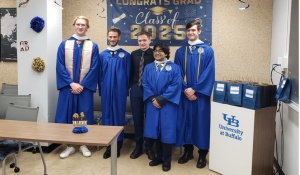
- Aaron D'Angelo (Physics BS with high distinction, Spring 25)
- Je Marc L.B. Breedy (Physics BA, Spring 25)
- John Kendall Brubacker (Computational Physics BS, Spring 25)
- Nalin Cooper-Sherrow (Physics BS, Spring 25)
- Justin Dillon (Physics BA, Spring 25)
- Patrick Gabriel Pampo (Physics BA, Spring 25)
- Anthony Vito Gagliardo (Physics BS with high distinction, Spring 25)
- Aniket Ghosh (Computational Physics BS with high distinction, Spring 25)
- Thomas Mcentire (Mathematical Physics BS with high distinction and departmental honor thesis certificate Spring 25)
- Joshua Darren Rath (Physics BS with distinction, Spring 25)
- Zach Reifsteck (Physics BS, Spring 25)
- Corey Jacob Young (Physics BS with high distinction, Spring 25)
- Challa Zirek (Physics/Physics Education BA, Spring 25)

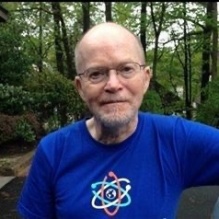
John Wilson, UB Physic PhD 1972
The Life of a UB Physics Alumnus: Reflections on Writing a PHD Thesis in the 1960s
By John Wilson, PhD
Intro by Xuedong Hu, Department Chair:
In October 2025, the Nobel Prize for Physics was awarded to John Clarke, Michel H. Devoret, and John M. Martinis for “the discovery of macroscopic quantum mechanical tunnelling and energy quantization in an electric circuit.” In the 1980s, the trio studied an electrical circuit with two superconductors separated by a thin layer of non-conductive material known as a Josephson junction, and demonstrated quantum tunneling between states that are localized in neighboring minima of the washboard potential created by the Josephson junction.
Interestingly, one of our UB Physics alumni, Dr. John Wilson, did experimental study of macroscopic quantum effects in a superconducting circuit with two Josephson junctions in the late 1960s. In the following article he reminisces about his study and work at UB, during a tumultuous period of time in the US.
I was really excited when this year’s Nobel Prize in Physics was announced. The citation to Clarke, Devoret, and Martinis sounded very similar to my dissertation, “Macroscopic Quantum Effects in Superconducting Rings Containing Two Josephson Junctions,” which was published in September, 1972.
The phenomena of Josephson tunnelling, for which Brian Johsephson shared the Nobel Physics Prize in 1973, were already established prior to my experiments. My work with tunnel junctions was conducted in the late 60s, quite soon after Josephson effect was first observed. As with most research, new discoveries evolve from a foundation of basic research that sometimes can be traced back for decades. I would like to think that my work contributed to the eventual exploration and understanding of macroscopic quantum tunnelling.
My interest in physics in general developed during my high school years in a public school in Wyoming NY where my senior class size was 28. Like myself, most were farm kids. In a class that size, all students got personal attention and encouragement. I labored on a farm and learned from my father how farm equipment worked or when it did not, how to fix it. My father was a high school graduate and my mother a graduate of Barnard College. She and a high school math teacher, directed me toward going to college and majoring in physics. I got married in 1965, graduated from college in 1966, and entered graduate school at UB.
Graduate studies at UB back then were full of challenges. In addition to typical technical challenges we have to overcome in the lab, there were many other twists in life that we had to navigate.
In 1965, the U.S. began large-scale combat operations in Vietnam, deploying ground troops and launching sustained bombing campaigns. Large-scale drafting of young males was underway using a lottery system. As a student in a hard-science discipline, I was granted a deferment from the Selective Service but that could have been revoked at any time. Fortunately, I had a high draft number (something like 200) so I was able to focus on my studies.
Buffalo’s campus unrest in the late 1960s reflected national tensions over civil rights, racial injustice, and the Vietnam War, with major protests erupting at UB. Buffalo became a hotbed of student activism and civil unrest, mirroring the broader national upheaval. Students occupied the administration building, several classrooms, and organized walkouts. For a period, classes were suspended. The media referred to UB as the “Berkeley of the East”.
In response to escalating demonstrations, in March 1970 city police in riot gear entered the campus and students clashed with police outside Hayes Hall. Tear gas was employed. The gas entered the laboratory where I was working and I had to suspend work for a while. The arrest of 45 faculty members who were in sympathy with the protestors further disrupted learning.
Those of us that completed dissertations in the 1960s faced a major challenge in communication that researchers today do not experience. We didn’t have the internet, smart phones, video conferencing, email, search engines, AI, Excel, laptop computers, etc.
For me one of the major disruptions was when my thesis advisor went on sabbatical in Taiwan for a year. This was around 1970, in my fourth year of graduate study, and I was into in the later stages of my lab work. This was pre-internet time, and telephone calls were expensive and not reliable. Mail was the only viable option. If I had a question or had written-up a portion of my research paper, I had to mail it to my advisor which would arrive in Taiwan a week or so later. He would take a few days to review it and mail it back to me. It could take 3 weeks or more between my mailing it and getting a response back!
For computing, I used the campus IBM 360 mainframe. For input, it required punch cards that I used to write equations. It supported batch processing and time-sharing, allowing multiple users to interact with the system. Often, I would need to run programs overnight because of time-sharing and low processing speed.
During my time of PhD study, we do not have the capability to conduct digital online searches, so research depended upon finding articles in hardcopies of physics journals. My primary source was the UB physics library. When I was done in 1972, only two hard copies of my thesis were made. One resides in the UB physics library and I have the other.
After graduation in the fall of 1972, jobs were had to come by. I took a two-year internship at the National Bureau of Standards (now the National Institute of Standards and Technology (NIST)) in Gaithersburg, MD. I worked in the Electricity Division where they were transitioning from defining the Volt using dry cells to using a Josephson Junction radiated with microwares. Knowing the precise frequency of the microwave produced a precise voltage.
At the end of my internship, I worked for several companies, but never again in my research specialty. However, having a solid background in physics did permit me to work in a variety of fields.
Now that I am retired, I keep intellectually engaged by finding and inviting speakers to make presentations to our retirement community’s Astronomy & Space Science Club that I started. UB’s two cosmologists have been a great gift for me: Dr. Will Kinney participated in one presentation and I’m working with Dr. Dejan Stojkovic on a remote presentation in February 2026. All Astronomy & Space Science Club presentations are recorded and recent presentations are available
Thank you for your support of the Department of Physics. With the support of alumni and friends, we can provide vital resources to enhance our department and provide support for students, research projects and programs. We are grateful for your generosity.
You can support your department and help to provide for our students by making a gift online.