Neuroscience
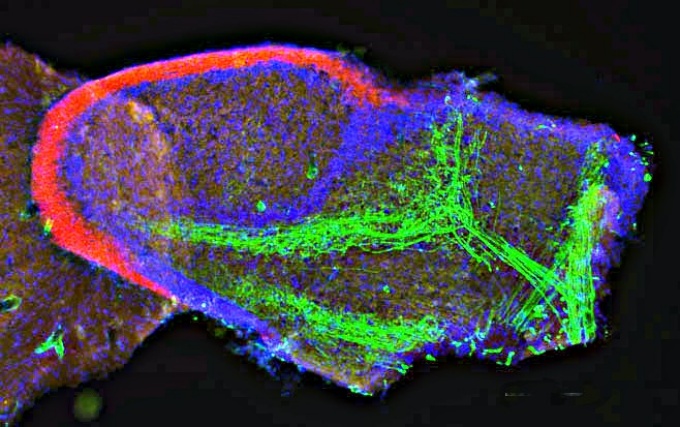
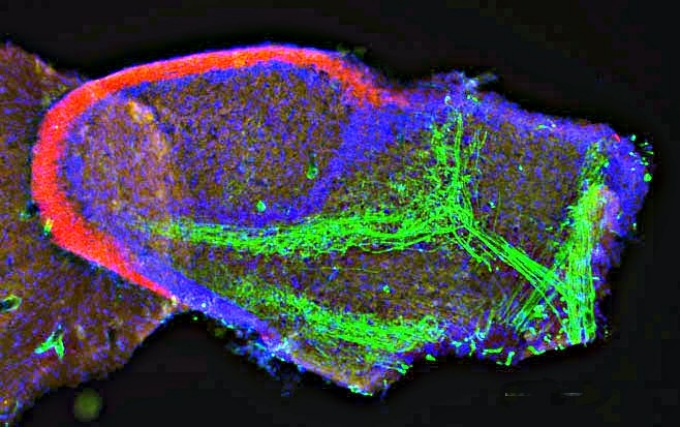
View of auditory nerve fibers (green) entering the cochlear nucleus (blue and red) (from Chanda et al., 2011)
How the brain senses, communicates and adapts
Neuroscience explores how nervous systems detect the world, process information and guide behavior. From sensory perception to disease, this research area investigates how neurons communicate, how circuits function and how disruptions can lead to neurological disorders.
Great for students interested in brain science, health and disease, sensory systems, behavior, psychology, medicine or biomedical research.
Neuroscience research asks fundamental questions about how the brain and nervous system work, including:
- How do neurons communicate with each other?
- How does the brain interpret sensory information like sound, taste and smell?
- How are signals transmitted across synapses?
- What goes wrong in neurodegenerative and neurological diseases?
- How do molecular and cellular processes shape behavior and perception?
These questions are central to understanding health, disease and human experience.
Neuroscience research connects molecular, cellular and systems-level approaches to understand nervous system function in health and disease. Studies may focus on individual neurons, neural circuits or sensory systems, depending on the question being asked.
Researchers use a wide range of experimental tools, including electrophysiology, imaging, molecular genetics and developmental biology, to reveal how neural signals are generated, transmitted and regulated.
Neuroscience research commonly explores:
- Sensory systems such as hearing, taste and smell
- Synaptic transmission and neural communication
- Signal transduction in neurons
- Neural development and circuit formation
- Neurodegenerative and neurological disorders
- Cellular and molecular mechanisms underlying behavior
Together, these approaches help explain how complex nervous systems function and adapt.
Connects naturally to
Animal systems biology, cell and molecular biology, cellular signaling, genetics, microbiology
Students can engage in neuroscience research through lab-based projects, independent studies and interdisciplinary collaborations that span biology, health sciences and behavior. Many students discover neuroscience through related fields and follow their curiosity into the lab.