Separations and Analysis

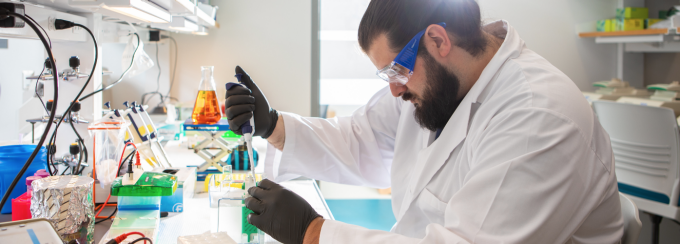
Precision at the molecular level
Separations and analysis research at UB focuses on developing advanced analytical methods that improve sensitivity, reliability and molecular-level understanding. Faculty apply these tools to complex chemical, biological and environmental systems, helping reveal processes that are difficult to observe.
On this page:
Separations and analysis research addresses questions such as:
- How can chemical separations be made more sensitive, reliable and efficient?
- How can complex mixtures be resolved to reveal molecular-level information?
- How do chemicals behave and transform in heterogeneous environments?
- How can analytical tools be used to study biological processes and environmental contaminants?
- How can measurement techniques be scaled for faster and higher-throughput analysis?
Separations and analysis research combines method development with advanced instrumentation to study complex chemical systems. Researchers design and refine separation techniques and analytical tools that improve detection, resolution and reliability.
Work in this area includes advanced mass spectrometry, chemical imaging at the micro- and nanoscale, surface analysis and X-ray diffraction. Many projects integrate fast analytical methods and high-throughput screening approaches, often through interdisciplinary collaborations.
Separations and analysis research at UB commonly includes:
- Fundamental studies of chemical separations
- Advanced mass spectrometry for biological and chemical systems
- Environmental analysis of emerging contaminants
- Chemical sensors and surface analysis
- Chemical imaging and crystallographic studies using X-ray diffraction

Students can gain hands-on research experience and build skills that translate to careers in analytical chemistry, biotechnology, environmental science, pharmaceuticals and graduate study.