PhD in Behavioral Neuroscience


Matthew Paul, PhD, in the lab with a student
Explore the biological foundations of behavior
The PhD in Behavioral Neuroscience at the University at Buffalo is a research-intensive program that prepares students for careers in academia, biotechnology and health-related fields. Using a range of laboratory approaches, students investigate the neural mechanisms that shape learning, motivation, sensation and addiction. You will gain the technical, analytical and communication skills needed to become an independent scientist, empowered to ask and answer innovative questions that advance our understanding of the brain and behavior.
Virtual Open House
We invite you to join us at our Virtual Open House on Wednesday, November 4 at 7:00 PM Eastern Time.
Learn about our MA and PhD programs through a Q&A with our Director of Graduate Studies, followed by breakout sessions with program representatives.
UB’s Behavioral Neuroscience PhD program is built on a core belief — to understand behavior, you must understand the biology behind it.
You’ll join a collaborative, research-driven community studying how the brain and body influence behavior. Faculty are leaders in fields like ingestive behavior, social behavior, addictive behavior and motivation. Through mentorship and lab experience, students gain the skills and confidence to become independent scientists, educators and innovators.
Graduates emerge as versatile researchers ready to make meaningful contributions in neuroscience, psychology, medicine and biotechnology.
- Degree type: Doctorate (PhD)
- Field: Behavioral Neuroscience
- Program length: Typically 5 to 7 years
UB’s program combines close faculty mentorship, advanced coursework and hands-on research. You will develop deep knowledge of the biological bases of behavior and build the skills needed for a wide range of scientific careers.
Program highlights:
- Mentorship-based training: Work directly with a faculty advisor whose research aligns with your interests
- Collaborative community: Engage with peers and researchers across UB’s cross-disciplinary neuroscience network
- Research-driven learning: Gain expertise in neuroanatomy, neurochemistry, electrophysiology and behavioral analysis
- Professional development: Build communication and teaching experience through seminars, colloquia and assistantships
Students graduate with deep scientific and technical knowledge in the biology of behavior and its application to neuroscience research. You will:
- Integrate neuroscience and psychology to understand complex behaviors
- Master research tools for studying brain-behavior relationships
- Design, conduct and analyze behavioral and neurobiological experiments
- Present and publish findings in scientific settings
- Develop skills in teaching, mentoring and academic communication
- Breadth of Knowledge: Students will demonstrate broad knowledge of psychology and ability to integrate these areas with behavioral neuroscience as measured by successful completion of core psychology classes and behavioral neuroscience electives.
- Experimental Design: Students will demonstrate the necessary skills and knowledge to design, execute and analyze meaningful experiments as part of focused program of research, as evidenced by successful completion of a dissertation project.
- Specialization in Behavioral Neuroscience: Students will demonstration broad and in-depth knowledge of the literature and sub-disciplines within Behavioral Neuroscience as measured by performance on their qualifying exam.
- Methodological Proficiency: Students will demonstrate technical proficiency of methods used to answer behavioral neuroscience research questions as measured by mentor feedback and successful completion of a dissertation project.
- Scientific Communication: Students will demonstrate the ability effectively communicate results of their research in written and oral form as measured during qualifying exams, departmental presentations, and via the written and oral descriptions of the dissertation project.
- Teaching: Students will acquire the necessary skills and knowledge to be effective college-level instructors as measured by student and faculty feedback from teaching undergraduate students.
- Data Analysis: Students will exhibit competence in statistical methods as measured by performance in their coursework.
- Ethical and Social Responsibility: All students will demonstrate an understanding of ethical and diversity issues as they pertain to the practice of scientific research.
Students train with advanced tools and modern facilities that support cutting-edge behavioral neuroscience.
Key training methods include:
- Behavioral and psychophysiological testing
- Chemogenetics, optogenetics and CRISPR/dCas9 gene regulation
- Electrophysiology, microdialysis and histology
- Fiber photometry and neural imaging
- PCR, Western blotting and molecular techniques
- Machine learning approaches to behavioral data
You will also participate in weekly colloquia, lab meetings and campus-wide neuroscience events.
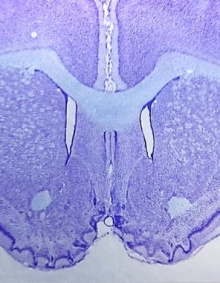
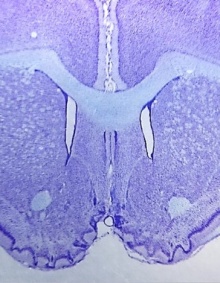
Thionin-stained coronal section of a rodent brain, from the Neurobiology of Habitual Behaviors Laboratory
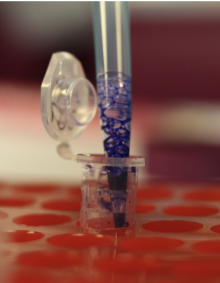
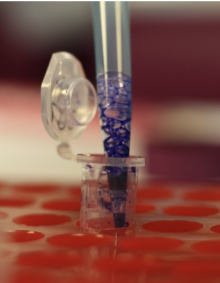
Analysis of salivary proteins in the Laboratory of Taste and Feeding
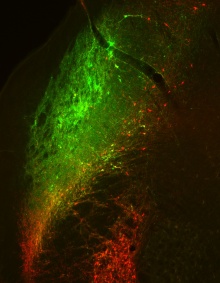
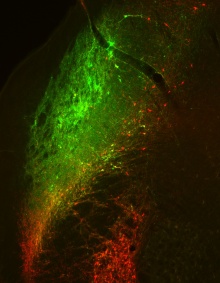
Immunofluorescent staining identifying two distinct populations of neurons, from the Neurobiology of Habitual Behaviors Laboratory
Mentorship
Each student works with a primary faculty mentor who guides research and professional development. Cross-lab collaboration is encouraged, and students may choose a second mentor for additional training.
Teaching experience
All state-funded students gain early teaching experience as teaching assistants. Many assist with Biopsychology (PSY 351) to strengthen communication and instructional skills.
Professional development
Weekly Brown Bag seminars build skills in research presentation, ethics and career development. Students also benefit from guest speakers and opportunities to present at conferences.
- Lab-first training: Hands-on work in core and affiliated labs across UB’s neuroscience community
- Cross-lab collaboration: Joint projects with on-campus and external research partners
- Community engagement: Buffalo Chapter of the Society for Neuroscience and the Neuroscience Graduate Student Association events during Brain Awareness Week and the Center for Ingestive Behavior Research Day
- Ethics and compliance: Ongoing research ethics discussions in area meetings plus required certifications in responsible conduct of research and animal care (CITI and IACUC)
Graduates of UB’s Behavioral Neuroscience PhD program are well prepared for careers in:
- Higher education: Faculty or research roles at universities and colleges
- Neuroscience and behavioral research: Academic, clinical or government institutions
- Pharmaceutical and biotech industries: Drug discovery, preclinical research and data science
- Science communication and policy: Translating research for broader impact
UB’s program emphasizes scientific rigor, critical thinking and technical mastery—skills that open doors across research, health and technology sectors.
Ready to advance your study of behavioral neuroscience?
View PhD Program Metrics
For more information, please reach out to us!

