PhD in Social-Personality Psychology

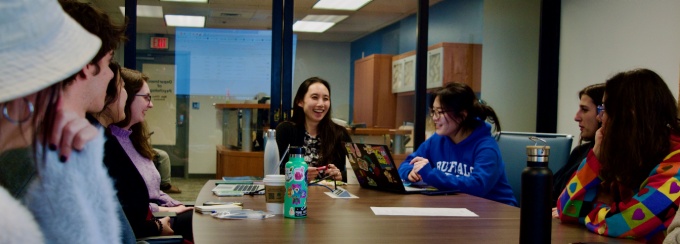
Lora Park, PhD, (center) in a graduate seminar with students
Explore how people think, feel and connect
The PhD in Social-Personality Psychology at the University at Buffalo offers an immersive, research-driven environment for students who want to investigate how individuals navigate the social world. Faculty are internationally recognized for their work on the self, stigma, prejudice, attitudes, prosocial motivation, relationships and stress and coping.
UB’s Social-Personality Psychology PhD program combines scientific rigor with a collaborative learning community. Students study how people understand themselves and others, exploring topics such as managing risk versus reward in relationships, the need to belong, concealing versus sharing our identities and confronting prejudice.
Through mentorship, hands-on research and collaboration with both faculty and peers, students develop the expertise and confidence to become independent researchers, educators and innovators in the field.
You’ll join a supportive research environment where faculty are leaders across the major topic areas in social psychology, providing both breadth and depth of training. Graduates leave prepared for impactful careers in academia, research institutions and data-driven industries where behavioral insight matters.
- Degree type: Doctorate (PhD)
- Field: Social-Personality Psychology
- Program length: Typically 5 years
UB’s Social-Personality Psychology program combines mentorship, coursework and independent research to train students in the science of social psychology. The structure emphasizes collaborative learning, faculty-guided research and professional development through meeting program milestones, as well as teaching and research presentations.
Program highlights:
- Comprehensive research training: Engage in empirical research from your first semester, gaining increasing independence throughout the program
- Expert faculty mentorship: Work with leading researchers and have the opportunity to publish in the top journals in the field
- Collaborative community: Join multiple labs and participate in research discussions at lab meetings and Brown Bag meetings
- Professional development: Build a scientific mindset and hone writing, data analysis and presentation skills for a variety of academic and applied careers
Students complete core courses in social psychology, advanced statistics and research design, plus elective seminars and departmental breadth requirements.
Training includes:
- Foundational coursework in theory, methods and analysis
- Electives in areas such as prosocial motivation, close relationships, social psychophysiology, stigma and attitudes
- A second-year project, third-year prelim paper and dissertation
- Teaching and professional development opportunities
Students develop skills to design, conduct and communicate research that explains how individuals function in the social world. You will:
- Gain deep understanding of key theories in social psychology
- Develop research design skills across multiple contexts
- Analyze data using advanced statistical methods
- Present findings at national conferences and publish in peer-reviewed journals
- Build teaching and mentoring experience in the classroom and the lab
- Demonstrate skill in critical review and evaluation of the current corpus of knowledge on the problem of interest.
- Exhibit competence in statistics and research methods.
- Demonstrate skill in planning and conducting independent theoretical and empirical research. This research will be of high quality and completed in a timely manner.
- Students will acquire knowledge and skills necessary to conduct themselves professionally and to prepare for careers in social psychology.
UB’s Social-Personality Psychology program uses a mentorship model that encourages both collaboration and independence. Each student works closely with a primary advisor and may collaborate with other faculty whose research aligns with their interests.
Current faculty research areas include:
- The social self and identity
- Stigma, prejudice and belonging
- Prosocial motivation and compassion
- Stress, coping and psychophysiology
- Attitudes and social metacognition
- Interpersonal relationships and well-being
Weekly Brown Bag meetings bring students and faculty together to share research and strengthen professional presentation skills. Students also attend professional conferences to expand their networks and academic presence.
- Research engagement: Conduct ongoing collaborative research and publish with faculty mentors in multiple labs
- Advanced data-analytic training: Develop mastery in modern statistical techniques to support rigorous, cutting-edge research
- Teaching experience: Lead undergraduate courses, building your skills while making a meaningful impact on student learning
- Professional growth: Present work at the Social-Personality Brown Bag series and regional, national and international psychology conferences
Graduates of UB’s Social-Personality Psychology PhD program pursue careers in academia, research, government and industry.
Common career paths include:
- University or college faculty positions
- Behavioral scientist or policy analyst in government or nonprofit organizations
- UX researcher, data analyst or consultant in corporate or tech settings
- Market or survey researcher across industries
UB’s training in research, writing and data interpretation prepares graduates to excel wherever understanding human behavior matters.
Ready to advance your study of social-personality psychology?
View PhD Program Metrics
For more information, please reach out to us!

