PhD in Clinical Psychology
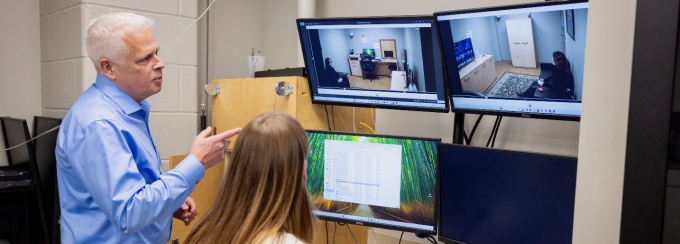
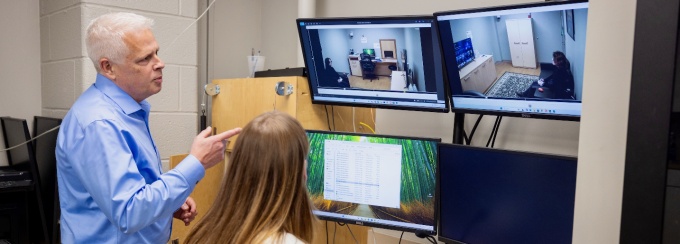
Larry Hawk, PhD, in the lab with a trainee
Train as a clinical scientist and advance mental health
The Clinical Psychology PhD program at the University at Buffalo follows a clinical-science training model. Students use scientific methods to inform assessment, understanding, treatment and prevention of problems in behavior, emotion, cognition and health. From the first semester, students engage in research with faculty mentors and build the skills needed for academic or research-oriented careers.
UB’s Clinical Psychology PhD follows a training model that keeps research, assessment and intervention tightly connected. We offer:
- Strong mentorship from faculty who are highly productive clinical scientists
- A research culture that emphasizes rigor, collaboration and impact
- Training that prepares you for competitive internships and postdoctoral positions
Faculty research strengths include alcohol and substance misuse, anxiety and mood disorders, developmental psychopathology, temperament, personality pathology, psychophysiology, assessment and advanced quantitative methods. You will learn to integrate science and practice in ways that improve mental health in real-world settings.
- Degree type: Doctorate (PhD)
- Field: Clinical Psychology
- Program length: 6 to 7 years, including a 1-year approved clinical internship
- Director of Clinical Training: Rebecca Ashare, PhD
- Associate Director of Clinical Training: Rebecca Schwartz-Mette, PhD
UB’s Clinical Psychology PhD program trains students to apply scientific methods to psychological assessment and treatment. The curriculum builds a foundation in research, clinical practice and professional ethics through mentored lab work, classroom instruction and supervised clinical experience.
Program highlights:
- Clinical-science model: Research-anchored training that embeds evidence in assessment and intervention
- Adult and child emphases: Opportunities across psychopathology and interventions for diverse populations
- Mentored research from day one: Join a lab, design studies, analyze data and share results
- Professional preparation: Build teaching, ethics and communication skills through seminars and supervised practice
Students complete sequenced coursework in psychopathology, assessment, intervention, statistics and research methods. Clinical practica begin in UB’s Psychological Services Center (PSC) and expand to approved community and hospital sites as students progress through the program.
Licensure and accreditation:
The Clinical Psychology PhD program (referred to as the “Program”) is licensure-qualifying for New York State. The program makes every effort to provide training that is consistent with national standards and to prepare students for the practice of clinical psychology. The practice of psychology is regulated at the state level. State licensing authorities, commonly referred to as “State Boards,” determine the specific educational and training requirements for licensure in their State. Of note, many States (including New York State) require post-doctoral training as well as examinations beyond predoctoral requirements. As such, a PhD from our Clinical Psychology program is not sufficient, in and of itself, to meet licensure requirements in most states.
The program is accredited by:
The program has been accredited by the American Psychological Association (APA) since 1949. The program was last reviewed in 2025 and received a full reaccreditation through 2035.
For questions regarding our APA accreditation status, please contact:
American Psychological Association
750 First Street, NE
Washington, DC 20002-4242
Phone: 202-336-5979
In addition to APA accreditation, the program was admitted to the Academy of Psychological Clinical Science in 2008.
The program is also accredited by PCSAS (Psychological Clinical Science Accreditation System) through 2027. PCSAS is an independent, non-profit organization that provides rigorous, objective, and empirically based accreditation of PhD programs. PCSAS programs adhere to a clinical science training model—one that supports and expands the scientific foundation for mental and behavioral health care and increases the quality and quantity of clinical scientists contributing to all aspects of public health for all people.
For questions regarding our PCSAS accreditation status, please contact:
Psychological Clinical Science Accreditation System (PCSAS)
Laura Namy, PhD
PCSAS Executive Director
818 18th St NW, Ste 810-1237
Washington DC, 20006
Phone: 771-241-5099
Students graduate ready to plan, conduct, evaluate and disseminate clinical science. You will:
- Integrate theory, methods and statistics to produce rigorous research
- Use empirically supported assessment and intervention practices
- Communicate research and case work effectively in writing and presentations
- Apply ethical and professional standards across research and practice
- Demonstrate broad knowledge across psychology and connect it to clinical science
- Students will acquire and demonstrate knowledge and skill necessary to plan, conduct, evaluate, and disseminate research in areas relevant to clinical psychology.
- Students will acquire and demonstrate knowledge and skills relevant to the theory and practice of clinical psychology, emphasizing theory-based, empirically supported approaches to understanding, evaluating, and intervening with clinical disorders.
- Students will acquire and demonstrate broad knowledge of psychology, and demonstrate ability to integrate these areas with clinical psychology.
- Students will acquire knowledge and skills necessary to conduct themselves professionally and to prepare for careers in clinical science. In addition to the above activities, in which students are socialized into academic clinical psychology, they are expected to behave in a professional manner.
- All students will demonstrate an understanding of ethical issues in research and clinical work.
- All students will demonstrate an appreciation of the importance of diversity issues in research and clinical work.
Clinical training begins in UB’s Psychological Services Center (PSC), where students receive supervision while providing assessment and psychotherapy for youth/adolescents and adult clients.
Advanced external practica have included:
- Erie County Medical Center: Inpatient adolescent groups and health psychology consultation
- Buffalo VA Medical Center: Integrated care interventions within funded research studies
- Oishei Children’s Hospital: Child and family assessment and treatment in an OMH-licensed clinic
Additional experiences may be available at Roswell Park Cancer Institute, the Psychological Services Center (PSC) child and group clinics, and community or forensic settings. Opportunities vary by year and supervisor availability.
Technical standards: Serving a diverse public
Students are trained to meet the needs of a diverse society. The program supports students in developing the knowledge, skills and attitudes necessary to provide competent care to individuals from varied backgrounds while maintaining a commitment to client welfare, safety and evidence-based practice.
- Research in action: Continuous involvement in clinical research with expectations to present and publish
- Campus and community partnerships: Opportunities with the Clinical and Research Institute on Addictions, Buffalo VA Medical Center, Buffalo General Hospital, Alberti Center for Bullying Prevention, Erie County Medical Center, Oishei Children’s Hospital and Roswell Park Cancer Institute
- In-house training clinic: Evidence-based assessment and treatment in UB's Psychological Services Center (PSC)
- Advanced practica: External placements at a variety of organizations and settings, as well as optional lab-based clinical experiences
- Professional development: Weekly Brown Bag meetings bring students and faculty together to share research and strengthen professional presentation skills. Students also attend regional and national conferences to expand their networks and academic presence.
Graduates pursue roles such as:
- Faculty member in psychology or psychiatry departments
- Clinical or research scientist in academic medical centers or hospitals
- Postdoctoral fellow in clinical science
- Research roles in government, nonprofit or industry settings
- Leadership in program evaluation, implementation science or policy
UB’s clinical-science focus builds versatility, critical thinking and analytic skill valued across research and practice settings.
Ready to train as a clinical scientist and help shape the future of mental health care?
View PhD Program Metrics
For more information, please reach out to us!

