PhD in Cognitive Psychology

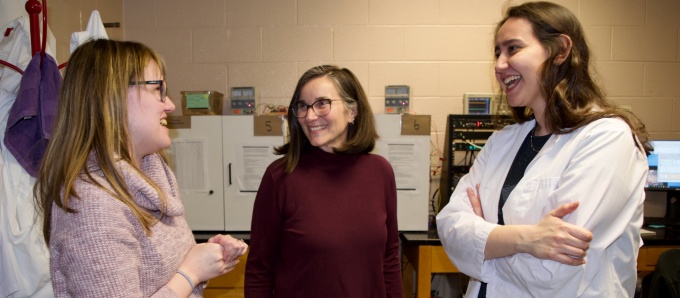
Micheal Dent, PhD, (center) in the lab with students
Explore how the mind works
The PhD in Cognitive Psychology at the University at Buffalo offers a research-intensive, collaborative environment for students who want to understand how people and non-human animals perceive, learn, remember and act. Faculty are internationally recognized for research in speech and language development and perception, word recognition, auditory perception, categorization, autism and animal learning.
UB’s Cognitive Psychology PhD program is built on a commitment to scientific rigor and discovery. Students explore how the brain and mind process information, form memories and guide behavior, working alongside faculty who are advancing knowledge across psychology, linguistics, neuroscience and computer science.
Through mentorship, hands-on research and collaboration across UB’s cognitive science community, students develop deep scientific expertise and the technical skills to become independent researchers, educators and innovators in the field.
You’ll join a collaborative research community that values mentorship, interdisciplinary study and scientific curiosity. Graduates emerge ready to make meaningful contributions in academia, technology, medicine and applied research.
- Degree type: Doctorate (PhD)
- Field: Cognitive Psychology
- Program length: Typically 5 to 6 years
UB’s program combines mentorship, coursework and hands-on research to train students in the scientific study of cognition. The structure emphasizes faculty-guided study, collaboration across UB’s cognitive science network and professional development through teaching and research presentations.
Program highlights:
- Research-first training: Begin mentored research in your first semester and continue throughout the program
- Broad methodological skill-building: Gain experience in experimental design, data modeling, EEG, eye tracking, motion capture, EMG and computational modeling
- Interdisciplinary collaboration: Work across psychology, neuroscience, linguistics and computer science
- Professional development: Build teaching, presentation and communication skills through seminars and conferences
Students complete coursework in cognitive psychology, statistics and related fields, along with independent research, professional development and teaching experiences.
Training includes:
- Core and elective courses in cognition, learning, linguistics and neuroscience
- Pre-dissertation and qualifying research projects
- Dissertation research and defense
- Participation in weekly brown bags and colloquia
- Mentored teaching and lab training
Students graduate with broad and deep knowledge of the mental processes that shape perception, memory, language and learning. You will:
- Integrate behavioral, computational and neuroscience approaches to studying cognition
- Gain proficiency in experimental design and quantitative data analysis
- Conduct and communicate original research
- Develop professional skills in teaching and mentorship
- Apply psychological science to address real-world questions about how we think and learn
- Students will acquire and demonstrate knowledge and skills necessary to plan, conduct, evaluate, and disseminate research in areas relevant to cognitive psychology. This includes competence in critical review and evaluation of the current corpus of knowledge available on the problem of interest, statistics and research methods, planning and conducting increasingly independent theoretical and empirical research, and disseminating the results of their work to the profession and broader community.
- Students will acquire and demonstrate knowledge and skills relevant to the theory and research in cognitive psychology. Students will demonstrate knowledge of modern scientific approaches to research on human and animal information processing, they will demonstrate knowledge in specialized areas of cognitive psychology, and they will demonstrate understanding of ethics and professional issues.
- Students will acquire and demonstrate a broad knowledge of psychology and demonstrate an ability to integrate these areas with cognitive psychology. Students will obtain knowledge of and an appreciation of diverse areas of psychology.
- Students will acquire knowledge and skills necessary to conduct themselves professionally and to prepare for careers in cognitive science and are expected to participate in professional activities at the department, university, community, and professional levels.
UB’s Cognitive Psychology program offers access to advanced laboratories and research tools for behavioral and neural investigations of cognition. Students gain hands-on training in techniques such as:
- EEG and event-related potential studies
- Eye tracking and motion capture
- Auditory and speech perception analysis
- Using AI to study neurodevelopmental conditions
- Animal psychophysics and comparative cognition
Students share findings through weekly Cognitive Area Brown Bag talks and the Cognitive Science Colloquia, connecting with peers and faculty across UB’s interdisciplinary research network.
Each student is paired with a primary faculty mentor at the time of admission and forms an Individualized Mentoring Committee that provides ongoing academic and research guidance. Students are encouraged to collaborate with faculty across UB’s Center for Cognitive Science and related disciplines to expand their expertise.
All state-funded students serve as teaching assistants during their first years, gaining valuable classroom experience. Students also present research at local and national conferences, publish findings with faculty mentors and develop skills for teaching and mentoring in academic and professional settings.
- Research collaboration: Work on projects across UB’s cognitive labs and interdisciplinary research centers
- Professional engagement: Participate in Cognitive Science Colloquia, Distinguished Speaker events and Cognitive Area Brown Bags
- Rotation projects: Partner with a second mentor to learn new techniques and research perspectives
- Certificate in Cognitive Science: Earn an additional credential through UB’s Center for Cognitive Science while completing your PhD
Graduates of UB’s Cognitive Psychology PhD program are prepared for diverse research and teaching careers in academia, government and industry.
Common career paths include:
- University or college faculty positions
- Cognitive or neuroscience research scientist
- Data science, UX or human-factors roles
- Science communication, policy or consulting
UB’s training model emphasizes versatility, scientific rigor and interdisciplinary collaboration—skills that translate across education, research and technology sectors.
Ready to advance your study of cognitive psychology?
View PhD Program Metrics
For more information, please reach out to us!

