BS in AI and Language and Intercultural Competence

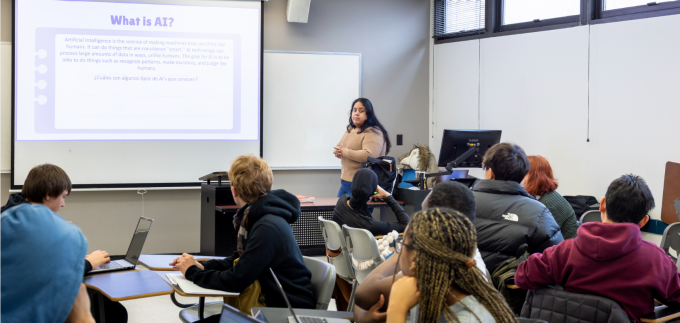
Design the future of communication across languages
How can AI help people communicate across languages and cultures? The BS in AI and Language and Intercultural Competence at the University at Buffalo combines artificial intelligence, linguistics and language study to explore this question. You'll develop technical skills, study a language in depth and learn how technology can support communication across communities.
An interdisciplinary approach to AI
This program is offered through the Department of AI and Society, the Department of Linguistics and the Department of Romance Languages and Literature, bringing together expertise from the College of Arts and Sciences and the School of Engineering and Applied Sciences. This collaboration connects technical innovation with real-world perspectives to prepare students for an AI-driven future.
Technology connects people around the world, but effective communication takes more than translation. This major helps you understand how language, culture and artificial intelligence work together to shape the way people share information and connect across communities.
You'll combine computational training with linguistics and advanced study of a language. Along the way, you'll explore how AI technologies can support multilingual communication while learning to recognize the cultural and social contexts that influence how language is used.
At UB, you'll benefit from:
Interdisciplinary learning


Combine artificial intelligence, linguistics and language study to understand communication from different perspectives.
Language and cultural expertise


Develop proficiency in a language while exploring the cultures and communities connected to it.
A focus on global communication


Examine how AI technologies can support communication across languages and cultural contexts.
A major research university


Access cutting-edge research, innovative technology and opportunities to explore real-world challenges.
UB: A leader in AI
At the University at Buffalo, you'll be part of a growing AI community with more than 400 researchers working across disciplines. Through initiatives like Empire AI and a National Science Foundation-funded National AI Institute, UB is advancing artificial intelligence to address real-world challenges and benefit society.
The BS in AI and Language and Intercultural Competence combines technical training with linguistic knowledge and language study, helping you understand how technology can support communication across cultures.
Your studies will include:
AI and society


Explore artificial intelligence, ethics and the ways emerging technologies influence communication and society.
Computing and mathematics


Build a foundation in computational methods, data analysis, linear algebra and probability.
Linguistics and language


Study how language is structured, interpreted and used across different communities.
Language specialization


Develop proficiency in a language while studying its cultural and social contexts.
Intercultural communication


Explore how language and cultural differences influence communication in global settings.
Capstone experience


Bring together your knowledge of AI, language and culture through an applied project.
Alongside AI and linguistics coursework, you will develop advanced proficiency in one language and study the cultures connected to it.
Languages by department
- American Sign Language
- Chinese
- German
- Japanese
- Korean
Romance Languages and Literatures
- French
- Italian
- Spanish
Your language specialization will help you build communication skills, cultural understanding and insight into how language is used in real-world settings.
You'll develop technical, linguistic and intercultural skills that help you understand how AI and language shape communication across communities.
You will learn to:
- Analyze how language is structured, interpreted and used across different cultures.
- Apply computational and quantitative methods to language-related challenges.
- Examine how AI technologies process and represent human language.
- Communicate effectively in your chosen language and understand its cultural context.
- Evaluate how technology influences communication, accessibility and cultural understanding.
- Recognize ethical challenges involving language diversity, bias and AI technologies.
You'll graduate with the ability to connect technical knowledge with language and cultural understanding to support communication across communities.
Put your skills into practice through language study, applied coursework and projects that connect technology with real-world communication challenges.
Depending on your interests and available opportunities, you may:
- Apply your language skills through conversations, presentations and cultural activities.
- Work with linguistic data to investigate how language varies across communities.
- Explore how AI technologies support translation, multilingual communication and accessibility.
- Connect with faculty whose teaching and research involve language, linguistics and technology.
- Complete a capstone project focused on a real-world challenge involving AI, language or intercultural communication.
These experiences can help you strengthen your language proficiency, apply technical skills and understand how technology can support communication across cultures.
Turn your skills in AI, language and intercultural communication into opportunities across technology, global business and public service. From improving multilingual digital tools to helping organizations communicate across cultures, you'll be prepared to connect technical knowledge with an understanding of language and people.
Industries you could work in
- Artificial intelligence and technology
- Language services and localization
- Global business and communication
- Education and accessibility services
- Government and public service
- Research and consulting
Potential career paths
- Multilingual technology analyst
- Language technology specialist
- Localization specialist
- Intercultural communication specialist
- Language data analyst
- Accessibility technology analyst
- Global communication analyst
Some career paths may require additional education, training or professional experience.
Employers are looking for people who understand both how technology works and how people communicate across cultures.
Ready to connect language, culture and technology? At UB, you'll build technical skills, deepen your understanding of a language and explore how AI can help people communicate across cultures and communities.
For undergraduate-related questions, please email rll-dus@buffalo.edu.


